

No products in the cart.
Contents
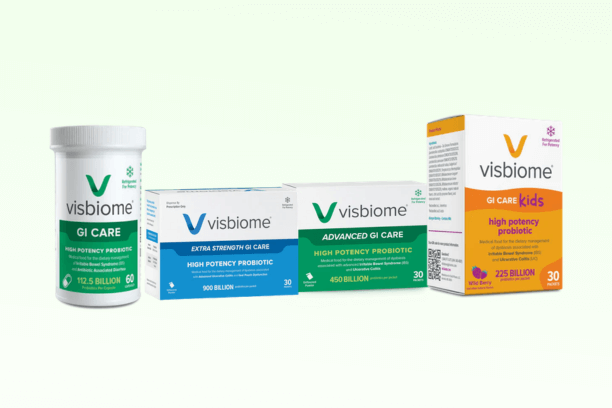
Visbiome focuses on high-potency, multi-strain formulations developed to support digestive health. It emphasizes clinically studied bacterial strains and claims to support specific gastrointestinal conditions.
The brand’s portfolio includes capsule and powder formats, along with higher-strength variations if you have more advanced gut health needs. It claims that its offerings may help manage Irritable Bowel Syndrome and support microbial balance in the gut.
In this review, we will examine Visbiome’s product range in detail and assess the structure and rationale behind its formulations. We will also compare it with similar probiotic brands to provide a clearer understanding of how it differs in formulation strength, research emphasis, and intended use.
About Visbiome
Developed by ExeGi Pharma, Visbiome’s products are built around the De Simone Formulation, a proprietary blend of eight live bacterial strains combined in a specific ratio. This includes four Lactobacillus strains, three Bifidobacterium strains, and one Streptococcus thermophilus strain. Visbiome claims that its formulation could help with the management of irritable bowel syndrome, antibiotic-associated diarrhea, and ileal pouch management.
As per the official website, Visbiome’s product lineup is organized by potency level and format. Its Visbiome GI Care Capsules provide 112.5 billion CFU in capsule form. Meanwhile, Advanced GI Care is offered in a powder format. Extra Strength GI Care is also available as a powder and is positioned for advanced ulcerative colitis and ileal pouch support.
Visbiome places emphasis on maintaining bacterial viability during shipping and storage. The brand highlights that its products are distributed under refrigerated conditions between 36–46°F, and shipments include temperature-monitoring sensors to help preserve potency. The formulations are Clean Label Project® certified and free from artificial preservatives and artificial colors.
Visbiome Offerings
-
GI Care Kids
GI Care Kids may help in managing Irritable Bowel Syndrome and Ulcerative Colitis in children. It combines three probiotic strains that could promote gut microbial balance and digestive function. The formulation focuses on supporting intestinal barrier integrity, microbial diversity, and immune signaling within the gastrointestinal tract.
Lactobacillus delbrueckii subsp. Bulgaricus in GI Care Kids could help maintain an acidic environment in the gut. It could inhibit the growth of harmful bacteria that prefer a less acidic pH by fermenting carbohydrates into lactic acid. This may also support digestion by assisting in the breakdown of lactose and other sugars.
The makers also added Streptococcus thermophilus in this formula, which works alongside Lactobacillus species in carbohydrate fermentation. It produces enzymes such as lactase, which might break down lactose in simpler sugars for easier absorption. This enzymatic activity may reduce gas formation and digestive discomfort.
-
GI Care
As per the official website, GI Care is formulated with three Bifidobacterium strains that are naturally found in the human gut. These bacteria might help maintain microbial balance, supporting intestinal barrier integrity and interacting with immune pathways in the digestive tract. The formulation centers on strains that primarily colonize the large intestine, where they participate in fiber fermentation and short-chain fatty acid production.
Bifidobacterium longum in this formula could help break down dietary fibers into acetate. It also competes with potentially disruptive microbes for adhesion sites and nutrients, which may help stabilize microbial composition.
The makers also added Bifidobacterium breve, which is involved in carbohydrate metabolism, particularly the fermentation of complex plant-derived fibers. Through this fermentation process, it produces metabolites that can help lower intestinal pH, creating an environment that limits the growth of certain harmful bacteria. GI Care also has Bifidobacterium infantis, which may help metabolize specific oligosaccharides and fibers, leading to short-chain fatty acid production that supports epithelial cell health.
-
Advanced GI Care?
Advanced GI Care is formulated for the dietary management of Advanced Irritable Bowel Syndrome (IBS) and Ulcerative Colitis (UC). It may influence microbial balance, intestinal barrier function, and immune signaling.
Lactobacillus acidophilus in this formula produces lactic acid through carbohydrate fermentation, which helps maintain an acidic intestinal environment. A lower pH can limit the growth of certain opportunistic microbes that thrive in less acidic conditions. L. acidophilus also adheres to epithelial cells lining the gut, which may support barrier stability by reinforcing tight junction proteins.
Advanced GI Care also contains Lactobacillus plantarum, which may help regulate microbial populations by inhibiting specific bacteria. L. plantarum also contributes to the metabolism of dietary fibers and polyphenols, leading to the formation of metabolites that support epithelial cell function.
-
Extra Strength GI Care
According to the official website, Extra Strength GI Care supports microbial balance and maintains mucosal stability in conditions where the gut environment may be altered. It contains Lactobacillus paracasei, which helps maintain an acidic intestinal environment that can limit the growth of certain opportunistic bacteria. This may also support barrier integrity by influencing tight junction proteins. I
Extra Strength GI Care also has Lactobacillus delbrueckii subsp. Bulgaricus, which may assist in breaking down certain sugars, supports digestive processes in the small intestine. Its metabolic byproducts can influence the mucosal surface and may help maintain a stable environment along the intestinal lining.
Visbiome Advantages
-
Peer-Reviewed Evidence Portfolio
Visbiome claims support from more than 25 peer-reviewed human clinical studies published in medical journals. These studies evaluate the exact high-CFU, multi-strain De Simone Formulation used in its product. The research focuses on GI dysbiosis and specific conditions such as IBS, ulcerative colitis, pouchitis, and hepatic encephalopathy. The brand presents this as condition-specific evidence rather than general probiotic research.
The company cites multiple randomized controlled trials. It reports statistically significant reductions in bloating and flatulence in people with IBS. In ulcerative colitis studies, it references remission rates reported as high as approximately 77% in certain trial settings. Additional trials examine reduced pouchitis relapse rates and lower incidence of hepatic encephalopathy and ammonia levels compared with placebo or standard care.
Visbiome states that these outcomes tie directly to its proprietary strain ratios and dosing levels. The studies evaluate the full De Simone blend, not isolated single strains. The brand emphasizes consistent results across different GI conditions using the same formulation structure.
This research base includes clinical data for specific conditions. The published randomized controlled trials can help you set more realistic expectations about symptom support. They may also make it easier for you to have informed conversations with your healthcare provider if you are considering a probiotic for IBS or ulcerative colitis.
-
Established Brand in GI Care
Visbiome launched in 2016, but the De Simone Formulation it uses has a much longer documented research history. The same multi-strain, high-CFU blend had already been evaluated in numerous clinical studies before the brand’s launch.
The company continues to reference peer-reviewed publications and medical food status for certain gastrointestinal uses. This reinforces that the formulation has been examined within structured clinical settings over time.
This extended clinical history influences how the brand presents its products. Visbiome builds its lineup around a formulation that has remained consistent across years of documented use. That continuity supports stability in strain composition and dosing, allowing the brand to maintain a consistent structure in its digestive support offerings.
Visbiome Limitation
-
Narrow Broad Retail Presence
Visbiome is sold mainly through its official website, specialty pharmacies, practitioner offices, and healthcare-focused online retailers. It is not widely available in major U.S. grocery chains such as Kroger or Walmart, and you typically will not find it at big-box stores like Target or in standard supermarket aisles. It is generally absent from the shelves where mass-market probiotic brands are displayed.
This reflects a controlled distribution strategy rather than broad retail exposure. The brand focuses on healthcare-linked channels instead of everyday store placement. This means you will likely need to order online or purchase through a pharmacy or practitioner. This limited access may reduce convenience and impulse purchases, especially if you prefer buying products in person or need immediate availability.
Visbiome Alternatives
-
VSL3
VSL3 structures its portfolio across refrigerated high-potency probiotic formulas and shelf-stable products. Its core range includes VSL3 Capsules, VSL3 Powder for IBS, ulcerative colitis, and pouchitis, and VSL3 DS Powder for ulcerative colitis and pouchitis. These products require refrigeration and are positioned as ultra-high-potency formulations verified to maintain labeled CFU counts through expiration when stored as recommended.
On the other hand, Visbiome centers its identity on high-potency digestive probiotics built around the De Simone Formulation. The brand highlights that its formula contains eight strains of live bacteria. Its indications include IBS, ulcerative colitis, antibiotic-associated diarrhea, and ileal pouch management. Unlike VSL3, Visbiome does not separate its lineup into lower-dose everyday products.
The product scope reflects this difference in structure. VSL3 extends beyond digestive formulas with VSL4 Gut Capsules at 30 billion CFU to support digestive balance and regularity, and VSL4 Vaginal Health containing prebiotic fiber, essential vitamins, and cranberry extract to support vaginal microbiota balance and urinary tract health. This broadens its coverage beyond strictly GI-focused use. Meanwhile, Visbiome maintains a narrower digestive focus with GI Care capsules, Advanced GI Care powder, Extra Strength GI Care powder, and GI Care Kids in a wild berry powder format. Its range concentrates on digestive intensity rather than expanding into adjacent wellness categories.
Storage and handling approaches also show contrast in emphasis. VSL3’s higher-potency formulas require refrigeration, while its VSL4 formulas are shelf-stable. The brand underscores potency guarantees through expiration when stored properly. Visbiome places a stronger emphasis on refrigerated shipping with temperature monitoring sensors to ensure product stability during transit, presenting cold-chain logistics as part of its quality assurance process.
VSL3 follows a broader category approach by combining ultra-high-potency refrigerated formulas with shelf-stable digestive and feminine support supplements. In comparison, Visbiome maintains a more concentrated digestive positioning built around the research depth and refrigerated distribution protocols.
-
Seed
As per their official website, Seed maintains a diversified portfolio that extends beyond digestive probiotics. It offers DS-01® Daily Synbiotic that contains 24 probiotic strains combined with a prebiotic. Additional offerings include the DM-02™ Daily Multivitamin, and it also offers bundled options such as the Daily Essentials Duo. This range covers digestive, pediatric, vaginal, cognitive, sleep, and micronutrient support. On the other hand, Visbiome’s product line remains concentrated on gastrointestinal dietary management. Its offerings include GI Care Capsules, GI Care Kids powder, Advanced GI Care powder, and Extra Strength GI Care powder, each positioned for specific digestive indications.
The formulation strategy further differentiates the two brands. Seed claims that its formula, like DS-01®, combines 24 strains across multiple genera, including Bifidobacterium and Lactobacillus species, with strain-level identification and deposition in the American Type Culture Collection. The company highlights whole-genome sequencing, flow cytometry measurement using Active Fluorescent Units (AFU), and SHIME® simulation to assess survival through the gastrointestinal tract. It also emphasizes controlled biofermentation conditions and dosage preservation across shelf life and shipping. Visbiome, in comparison, combines 8 strains in the De Simone Formulation in its offerings.
Seed integrates sustainability into its product design and packaging, including refillable glass jars, post-consumer recycled materials, biodegradable PaperFoam trays, compostable biofilm pouches, and carbon footprint auditing in partnership with Planet FWD. On the other hand, Visbiome emphasizes cold-chain shipping with refrigeration and temperature monitoring sensors to protect probiotic potency, highlighting storage and handling controls rather than environmental initiatives.
Pricing structures align with these positions. Seed’s range covers from $34.99 to $99.00, with its flagship synbiotic positioned at $49.99 in the mid-premium segment. Meanwhile, Visbiome’s products range from $69.95 to $189.95, reflecting its high-potency formulation and medical food classification.
Seed operates as a broad microbiome-focused company with diversified applications and sustainability initiatives. Visbiome functions as a specialized digestive brand centered on clinically studied, high-potency formulations for digestive health.
Pros
- The brand centers its identity around the De Simone Formulation.
- Visbiome offers capsule and powder formats for flexible use.
- The brand differentiates between GI Care and Advanced formulas.
Cons
- The brand’s clinical claims require you to review study details independently.
- Many users highlighted in independent reviews that they found Visbiome’s products to be expensive.
How Did We Evaluate?
-
Brand Reputation
Visbiome claims that its formulations are based on the De Simone multi-strain blend, which may promote gut microbiome management. On Tenereteam, the brand holds a 4.0 rating based on 11+ reviews. The rating suggests generally positive user experiences. However, the relatively small number of reviews limits its statistical significance and overall representativeness. The score can be viewed as moderately favorable, but it is not strong enough to draw definitive conclusions about broader customer satisfaction.On the other hand, Visbiome does not currently appear on the Better Business Bureau. While absence from BBB does not inherently signal negative standing, it limits visibility into formal complaint records and customer service dispute tracking.
Our evaluation indicates that the brand demonstrates structural credibility through its research-backed formulation and clinical positioning. However, the absence of a listing limits publicly accessible information regarding complaint history and formal dispute resolution, which might make it challenging to understand the brand’s credibility through these external sources.
-
Real User Experiences
Our evaluation of Visbiome is based on Amazon reviews of the brand’s offerings. The Advanced GI Care holds a 4.6 rating based on 734+ reviews. Some users claimed they used it during cleanse routines, while many highlighted its role in managing IBS symptoms, bile acid malabsorption, and post-antibiotic gut recovery. Many highlighted they noticed improvements in bloating, diarrhea, and overall digestive discomfort after using the formula. At the same time, a few users claimed the formula felt strong at the recommended dose and suggested tapering into it gradually.Visbiome GI Care High Potency Probiotic has received a 4.7 rating based on 4,000+ reviews. Some users mentioned that the capsules supported their digestive health. Many also highlighted noticeable stabilization in digestion and reduced bloating with consistent use.
The feedback suggests that Visbiome is perceived as a high-strength probiotic brand with consistent customer satisfaction. Its reputation appears to be driven by potency, physician association, and controlled shipping practices, while higher pricing and potential sensitivity at full dosage remain recurring considerations.
Frequently Asked Questions
- Does Visbiome disclose full strain-level identifiers for each bacterial strain?
Yes. The brand lists all eight strains of the De Simone Formulation with full DSM and proprietary SD identifiers on its official website. Examples include Lactobacillus acidophilus DSM24735/SD5212 and Streptococcus thermophilus DSM24731/SD5207, with consistent disclosure across its platforms. - Does Visbiome offer low-dose probiotic options?
No. The brand positions its products as high-potency formulations, with capsules providing 112.5 billion CFU each and sachets delivering 450 billion CFU per packet. The minimum daily serving starts at one 112.5 billion CFU capsule, with no lower-dose alternatives available. - Does Visbiome offer flavored or chewable probiotic formats?
No. The brand does not offer chewable tablets or gummies. Its lineup includes unflavored capsules, high-potency powder sachets, and a wild berry–flavored GI Care Kids powder, which is not chewable.
Conclusion
Visbiome organizes its products by potency and format to address varying dosage preferences and age groups. However, its high CFU concentrations may not be necessary if you are seeking general digestive support and can be associated with temporary digestive adjustment effects. Refrigeration is required to maintain viability, which introduces storage and transport considerations. Distribution is largely limited to official channels, specialty pharmacies, practitioner offices, and healthcare-focused retailers, reducing availability in mass-market stores.
When considering the brand, it is important to consult a doctor if you are immunocompromised, managing complex conditions, or undergoing intensive procedures. Consistent refrigeration and careful handling are important to preserve strain viability, and gradual introduction may help minimize temporary digestive changes.
Visbiome claims to offer high-potency probiotic options mainly for targeted digestive support. However, limited store availability, the need for refrigeration, higher cost, and research focused mostly on specific conditions remain key factors to consider.

Rachel has been a freelance medical writer for more than 18 years. She graduated from the University of Tennessee at Knoxville in 2005 and is currently practicing as a Certified Registered Nurse Anesthetist at a Level I trauma center.
Leave a Reply