

No products in the cart.
Contents
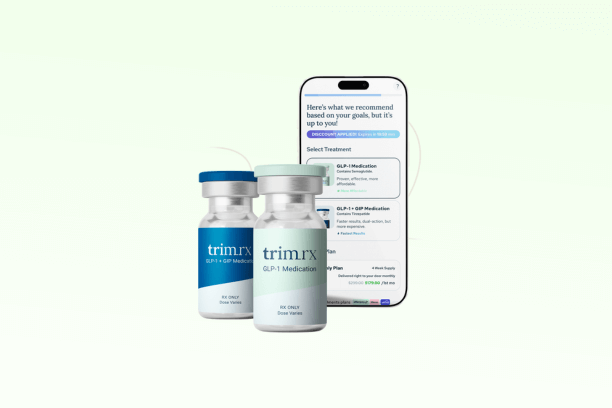
TrimRx is a telehealth-based platform that focuses on supporting weight management goals through prescription-based medications and programs. The platform offers access to virtual consultation with licensed clinicians, customized programs, and medication delivery.
The platform’s programs may offer support for common fitness goals, including appetite suppression, metabolism support, and energy metabolism. It also offers access to unlimited check-ins with the provider and a dedicated portal for ongoing support.
In this review, we assess TrimRx’s platform structure, how clearly it explains eligibility and clinician steps, its offerings, and how clearly the platform communicates safety details and program limitations.
About TrimRX
Founded by Emily Parker and Jake Miller, TrimRx offers personalized weight management programs revolving around prescription medications, with access initiated through an online assessment and optional telehealth support.
The program begins with a short, quiz-based intake to determine program eligibility. Following the responses in your quiz, licensed clinicians may approve and prescribe compounded offerings/programs if appropriate, with the platform arranging for medication delivery to the specified address.
According to its official site, the platform offers prescription medications available in both injectable and oral forms. Beyond compounded offerings, the platform may also provide access to brand-name options, depending on availability and eligibility.
The platform also offers an Essentials line, presented as an add-on, non-prescription option. The range features a fat-burner called Weight Loss Boost alongside a Daily Support formulation that pairs ingredients such as berberine, chromium, and alpha lipoic acid.
TrimRX Offerings
-
Weight Management
Within its weight management segment, the platform can provide access to clinician-supervised programs that are based on compounded formulations. After a consultation and review by a licensed clinician, a compounded prescription may be issued by the provider, based on clinical judgment. Ongoing care and continued support are then handled through the platform’s online portal.
As part of the compounded offerings, compounded semaglutide could mimic the effects of GLP-1 hormones, which work by reducing post-meal glucose spikes, delaying the rate of gastric emptying, and improving satiety signaling in the hypothalamus. Such effects may help curb hunger-driven cravings, potentially reduce total calorie intake, and support metabolic control. These factors may help contribute to your fitness goals.
If eligible, the clinicians may provide access to compound tirzepatide, which works by mimicking the activity of two naturally occurring gut-derived hormones, namely glucagon-like peptide-1 and glucose-dependent insulinotropic polypeptide. Such effects may enhance glucose-dependent insulin release while also suppressing glucagon signaling, which may reduce sharp fluctuations in post-meal glucose. These hormonal effects may translate into reduced hunger frequency, faster satiety after meals, and better adherence to calorie control.
Based on the clinician’s discretion and availability in the current inventory, the platform may also provide access to some brand-name offerings. These include options like Wegovy, Mounjaro, Ozempic, and Zepbound.
TrimRX Limitations
-
Customer Support Consistency Gaps
Public reviews show repeated breakdowns in TrimRX’s customer support. Users across Trustpilot, BBB, and Reddit report live chats left unanswered after long waits, sometimes exceeding 45 minutes. Others describe phone calls that ring without voicemail pickup and emails that go unanswered for 7 to 14 days, especially for billing issues such as unexpected charges or subscription renewals.
Many complaints also point to support handoff problems. Customers report being sent back and forth between general support and clinician channels, with each side redirecting responsibility. These loops have appeared in multiple BBB complaints since mid-2025, turning simple requests into multi-week delays.
For a health-related service, this inconsistency can weaken trust. Delayed responses and unclear ownership create stress around time-sensitive needs like refills, cancellations, or account changes. While some users eventually receive help, the pattern suggests uneven support execution rather than isolated incidents.
-
Limited Pharmacy Partner Visibility
TrimRX operates as a coordinating telehealth platform rather than an integrated pharmacy provider. It relies on external compounding pharmacies to dispense medications written by licensed clinicians. This structure limits TrimRX’s direct oversight of compounding steps such as potency testing, sterility controls, and batch verification.
The brand states that partner pharmacies meet regulatory standards, including FDA 503A or 503B registration and state licensure. However, the platform does not publicly disclose the identities, locations, or facility profiles of these pharmacy partners. Customer reviews also note variability in shipment origins, such as different compounding hubs across states, without clear batch traceability or documentation.
This lack of transparency reduces end-to-end visibility. Compared with platforms that operate owned or openly disclosed pharmacies, TrimRX provides fewer concrete details for independent due diligence.
Pros
- Features LegitScript certification, indicating commitment to regulatory and telehealth compliance standards.
- Provides ongoing provider support via unlimited check-ins, matching personalized care claims.
- The platform supports convenience by arranging for shipment and medication delivery to your address.
Cons
- Lack of insurance coverage may lead to higher medical costs for programs.
- Independent reviews indicate concerns with shipment delivery and unexpected charges.
TrimRX Alternatives
-
Yucca Health
Yucca Health and TrimRx both function as telehealth platforms that provide prescription programs, home delivery of medications, and ongoing provider support. However, the platforms differ in how onboarding is structured, the range of programs and offerings, pricing structure, and program continuity.
The Yucca Health platform is built around asynchronous eligibility screening and provider review, with fulfillment through partner pharmacies. Meanwhile, TrimRx’s service model is framed around a fast qualification journey beginning with a free two-minute Assessment quiz and moving rapidly into prescribing and shipment.
Identity verification is also a clear point of difference between the platforms. Yucca Health explicitly includes identity verification during onboarding, requiring you to enter either the last four digits of a social security number or a government-issued ID upload before provider review proceeds. On the other hand, TrimRx does not emphasize an identity verification gate in the provided details, and instead keeps the process messaging focused on a short assessment, quick review, and fast shipment.
Both platforms are positioned around GLP-1 weight management programs, with some differences in the breadth of services. Yucca Health organizes its services around two Personalized Programs that feature compounded offerings intended to minimize hunger cravings, boost metabolism, and support fitness goals. Beyond compounded options, the platform also offers access to brand-name options like Wegovy and Zepbound. Meanwhile, TrimRx positions its service catalog as broader in format and variety. The platform offers access to both oral and injectable compounded medication programs. Based on availability and clinical discretion, it may also provide access to brand-name options like Zepbound®, Ozempic®, Wegovy®, and Mounjaro®. Beyond these, the platform offers a non-prescription option that includes two products called Daily Support and Weight Loss Boost.
Yucca Health positions access through commitment tiers, including monthly, 3-month, and 6-month plans, with continuity language built around recurring shipments and structured billing patterns, such as billing every six months. Meanwhile, TrimRx does not emphasize long commitment tiers and instead frames its programs around transparent price points and bundled care elements such as free consultation, medication, delivery, and unlimited check-ins with providers.
-
Fridays
When comparing the platforms, Fridays and TrimRx both function as digital healthcare platforms that focus on clinician-supervised care across fitness goals. However, the platforms have some nuances in terms of their service structures, range of offerings, support ecosystem, pricing structures, and scope.
Fridays positions itself as a lifestyle-focused telehealth platform built around an expansive ecosystem that pairs prescription-led care with coaching support and educational content covering multiple fitness and lifestyle categories. These categories are tied to weight management, longevity, testosterone, microdosing, and hormone-related support. Services are delivered through both web-based and mobile interfaces, with a strong focus on maintaining continuity across different programs. Meanwhile, TrimRx positions itself around a more restricted model, focusing its services on supporting weight management goals. The platform emphasizes streamlined onboarding through two-minute quizzes, operational speed, and bundled medication delivery within a single framework.
In terms of weight management care and pricing structure, there are some contrasts between the platforms. Fridays provides access to various formulation types and delivery formats, including custom programs (both injectable and oral). It also provides access to brand-name options like Ozempic and Zepbound. As per its official website, the pricing for customized preparations starts at $140–$250/month, and brand-name options start at $1490–$1830/month. Meanwhile, TrimRx presents a more uniform pricing structure, highlighting distinct monthly rates based on customized preparations, which typically start at $160–$355 per month, while the brand-name options start at $1140–$1580 per month. The platform also offers non-prescription offerings like Daily Support and Weight Loss Boost, which are priced between $119 and $150.
Fridays extends beyond the conventional weight-management-focused segment into adjacent categories. One such area involves Microdosing programs, around areas such as recovery, energy, muscle function, and metabolic support. Hormone-related services include offerings like Oral Testosterone and Injectable TRT, while longevity-focused programs feature offerings such as B12-MIC, NAD+, and Sermorelin. Meanwhile, TrimRx does not offer comparable programs, keeping its services exclusively to supporting weight management goals.
Both platforms include regulatory disclosures, although the emphasis and framing differ between them. Fridays consistently notes that its personalized formulations are compounded in FDA-registered facilities, while also clarifying that these preparations are not FDA-approved for safety, effectiveness, or manufacturing quality. The platform further states that access to medication is not assured and that all prescribing choices are made exclusively by licensed clinicians. Similarly, TrimRx reinforces that program and prescription decisions remain at the clinician’s discretion, while also drawing attention to HIPAA-related compliance and its stated refund conditions.
Brand Credibility of TrimRX
In evaluating TrimRx’s reputation, we analyzed the ratings and reviews received by the platform on Trustpilot, where the platform currently maintains a 3.8 out of 5 score based on 500+ ratings.
The Trustpilot profile indicated a recurring pattern of frustration around cancellation and refunds, including reports that cancellation requests were made quickly, but the order was still processed. Another theme involved product fulfillment mismatches, where a user stated they selected an oral version but received an injectable version. At the same time, a few Trustpilot reviews describe smooth experiences and positive interactions with staff.
Our evaluation of the brand indicates repeated friction areas that directly influence credibility and customer trust. These include consent clarity around moving forward with services, refund eligibility boundaries, cancellation timing, and responsiveness in portal or phone-based support. The repetition of similar complaints indicates perceived consistency and clarity may remain uneven, which might reduce the platform’s credibility.
Frequently Asked Questions
- Does TrimRx guarantee approval for prescription medications?
No. The platform does not guarantee prescription approval. It requires you to complete an online health questionnaire/intake form, which licensed clinicians review. Prescriptions are issued only if medical eligibility criteria are met, and providers may reject the application if you do not qualify. - Are there any risks with TrimRx’s GLP-1 programs?
Yes. The platform’s GLP-1 programs may involve medication risks. Potential side effects may include vomiting, nausea, diarrhea, constipation, or abdominal pain, especially during dose increases. More serious risks may include pancreatitis or gallbladder problems. - Does TrimRx integrate lab test support in its services?
TrimRx mentions laboratory testing in a clinical context only. It notes that prescribing clinicians may review labs (e.g., HbA1c, metabolic panels, thyroid markers) to assess eligibility for plans. However, it does not order, bundle, or manage labs, nor does it list partner or in-house testing workflows. You are expected to obtain any required bloodwork independently (e.g., through a PCP or third-party lab).
Conclusion
TrimRx positions itself as a digital-first platform built around clinician-supervised weight management programs. Its service flow and online intake are designed for speed and convenience. The platform also highlights LegitScript certification and compliance with state-level telehealth compliance.
However, the platform’s compounded-first model creates limits that should be weighed carefully. Compounded medications introduce variability compared with FDA-approved branded products, including potential differences in potency consistency, sourcing controls, and sterility assurance depending on the pharmacy partner involved.
It is important to note that the outcomes and experiences with the program may vary based on factors like adherence, baseline metabolic health, nutrition, activity level, and long-term behavioral support. The programs may work best when you prioritize convenience and virtual access, but they still require close attention to compounded medication trade-offs, pharmacy transparency gaps, and support responsiveness.

Rachel has been a freelance medical writer for more than 18 years. She graduated from the University of Tennessee at Knoxville in 2005 and is currently practicing as a Certified Registered Nurse Anesthetist at a Level I trauma center.
Leave a Reply