

No products in the cart.
Contents
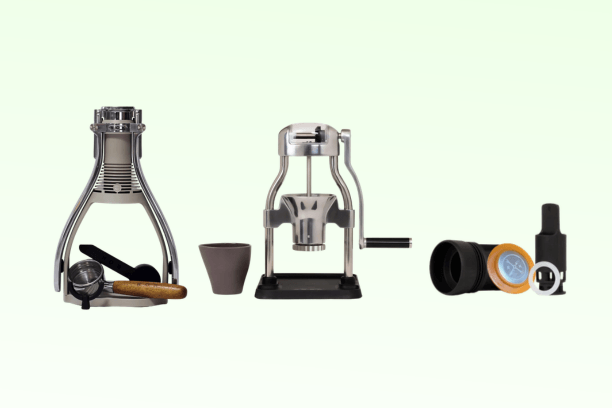
ROK is a coffee equipment brand focused on manual coffee-making tools, particularly for espresso and hand grinding. Its product range includes manual espresso makers, coffee grinders, pour-over brewing equipment, coffee storage, milk frothers, and replacement parts.
The brand states that its manual equipment also addresses practical considerations such as limited counter space, portability, maintenance, and the need for replaceable parts.
In this review, we will examine what ROK offers, including its main product categories and their intended uses, and examine customer feedback to understand how the products perform in practice.
About ROK Coffee
ROK Coffee is focused on manual espresso and the home coffee-making experience. It aims to create compact, durable, and easy-to-use equipment that delivers café-quality espresso without bulky machinery, complex maintenance, or advanced barista skills.
According to the official website, the brand’s portfolio extends beyond espresso machines to encompass a broader manual coffee ecosystem. Its core range includes the Presso Smartshot and EspressoGC espresso machines, the GrinderGC PLUS, and supporting products such as the W1 Filter, Milk Frother, Zero Jar, Beech Tamper, Grounds Cup, and Presso Silicone Mat. The brand also offers bundles and a range of accessories designed to support the complete coffee-making process, from grinding and dosing to extraction and serving.
ROK Coffee Offerings
-
Espresso Machines
ROK Coffee’s espresso machines focus on manual brewing, so you stay involved in preparing and extracting each shot. Its Presso Smartshot is available in Black, Soft Teal, and Warm Grey, offering three finish options for the same model.
The brand highlights that its EspressoGC range includes the Classic PLUS and Black PLUS, providing two additional machines in the lineup. Across these options, the emphasis is on a straightforward espresso setup where grinding, dosing, tamping, and extraction remain part of the process.
-
Coffee Grinders
The grinder range is built around the GrinderGC PLUS, with supporting parts for upgrading and maintaining the equipment. Under this, you will get the GrinderGC Upgrade Kit, which is available for making changes to an existing grinder, while the Grinder Bevel Gears are replacement parts for the grinding mechanism. This gives you the main grinder along with a couple of ways to keep the equipment functional or modify it as needed. For a manual espresso setup, the grinder is also an important part of the workflow since the coffee needs to be ground before it reaches the portafilter.
-
Coffee Brewing & Filtration
According to the official website, Coffee brewing and filtration include the components used to prepare coffee and to manage the extraction process. Its W1 Filter, Competition Filter Screen, and SmartShot Basket serve different filtration and basket-related functions, while the Portafilter, Naked Portafilter, and Presso Smartshot Portafilter provide different portafilter options for the brewing setup. The Conversion Kit and Commercial Edition Plunger are available for specific equipment configurations, while the Dosing Funnel helps guide coffee grounds into the basket during preparation. These are mostly functional components that let you replace individual parts or adjust the setup without having to replace the entire machine.
-
Coffee Storage & Preparation
The storage and preparation accessories cover a few of the steps around the actual espresso extraction. The maker highlights that the Zero Jar is used for coffee storage, while the Beech Tamper is part of the preparation process before brewing. The Milk Frother adds an option for preparing milk-based coffee drinks, and the Presso Silicone Mat gives you a dedicated surface for the Presso setup. These products do not change the core brewing equipment, but they fill in some of the practical pieces you may use before, during, or after making an espresso.
ROK Coffee Advantages
-
Open Coffee Ecosystem
ROK claims that its equipments work with coffee from local roasteries, supermarkets, value blends, or specialty sources, without requiring a proprietary coffee supply. The W1 Filter uses generic conical filter papers, with the brand recommending Size 02 papers such as Hario V60. With the EspressoGC, you can choose between the brand’s spouted or naked portafilters and adjust the grind, dose, and tamp based on the coffee you’re preparing. You can change coffee brands and use commonly available filter papers without being tied to proprietary coffee pods.
-
Product Longevity Framework
ROK designs its equipment for long-term ownership, with warranty coverage varying across the range. The EspressoGC and GrinderGC carry 10-year warranties against functional defects in materials and workmanship, while the Presso Smartshot has a 2-year warranty. However, the Zero Jar and W1 Filter have some variation in how warranty coverage is presented across the official site.
The brand also provides service kits, replacement parts, and upgrade components. It gives you more support for keeping the equipment in use over a longer period, with access to replacement components when routine wear occurs.
The brand’s products are intended as longer-term purchases, with defined warranty coverage and replacement-part support. You should still account for routine wear and verify the warranty terms for the Zero Jar and W1 Filter.
ROK Coffee Limitation
-
Component Dependency Constraints
ROK’s proprietary engineering creates a component-compatibility burden across its product range. Its equipment uses dimensions outside the common 54mm and 58mm espresso standards, which can restrict compatibility with generic third-party components such as aftermarket baskets, standard portafilters, and off-the-shelf grinder burrs.
Although the brand offers service kits, replacement parts, and upgrades, you may have fewer alternatives when a specific component needs replacing. Long-term maintenance can therefore remain dependent on the brand’s continued manufacture and supply of compatible parts. You may have less flexibility when sourcing replacement components, and limited parts availability could make maintaining the equipment more difficult over its intended long-term ownership period.
ROK Coffee Alternatives
-
Flair Espresso
Flair Espresso and ROK Coffee both focus on manual coffee preparation, but their product structures and approaches differ substantially. According to its official website, Flair focuses on manual espresso extraction, direct lever operation, and control over brewing variables. ROK takes a broader approach by accommodating either minimal effort or greater control. Its Presso Smartshot is designed for simple preparation, while the EspressoGC is intended for users who want to work with grind, puck preparation, and extraction.
Flair’s espresso machine range includes the Flair 58 Plus 2, Flair 49 PRO, Flair Classic, and Flair 2GO. Its Flair 58 Plus 2 is the highest-specification model, combining a direct lever with control over brew variables and a 58mm portafilter system. The brand’s Flair Classic uses a completely manual lever and is specified for 6–9 BAR pressure. Across these four machines, Flair changes the format, size, and level of control while retaining the same manual extraction approach. In comparison, the ROK’s espresso range is more clearly divided by the amount of effort and technical knowledge the user wants to invest. Its Presso Smartshot is designed to reduce the technical requirements normally associated with espresso preparation. The brand states that the Smartshot requires no effort, while still allowing you to choose specialty coffee, local-roaster coffee, or supermarket blends. The machine also allows experimentation with cola, tonic, or Red Bull.
The level of control is one of the clearest differences between the two ranges. Flair explicitly specifies pressure-related and preheating features on its machines. Its 58 Plus 2 includes a pressure gauge with valve control and an integrated preheat system, while the 49 PRO comes with a pressure gauge and is designed for easy preheating. Its Classic provides a stated 6–9 BAR brewing range. These specifications make pressure and preparation visible parts of the Flair product design. However, ROK does not provide equivalent pressure-gauge or valve-control specifications for the Presso Smartshot or EspressoGC. Instead, its EspressoGC description places greater emphasis on the user’s preparation technique, particularly grind calibration and puck preparation.
Portability is addressed differently by the two companies. Flair has a specific portable model, the Flair 2GO, which folds into a compact case while retaining a lever-based, bottomless espresso format. This makes portability a defined product category within Flair’s range. ROK instead describes mobility as a characteristic of its manual machines generally. The company describes its espresso makers as simple, lightweight, robust, and ready to use immediately. They can be used without taking up substantial worktop space or power sockets. ROK also connects portability with reduced cleaning and maintenance requirements.
The two companies also build different types of supporting product ecosystems. Flair offers the Royal manual grinder, Flair Brew Scale, Flair Weigh Cup, and Flair Café Kettle, as well as espresso machines and milk-steaming products. The range also includes curated kits, bundles, and refurbished Flair machines. ROK’s accessory range is more extensive for replacement and modification components. It offers the GrinderGC PLUS at $249, the EspressoGC Black PLUS and EspressoGC Classic PLUS at $259, and a Super Bundle at $499, compared with the regular $557. It also offers service kits, conversion kits, portafilters, baskets, tamper, grinder upgrades, hopper covers, silicone mats, and other components.
Flair gives you more control over the espresso extraction itself, especially through pressure monitoring and preparation features. ROK places greater emphasis on mechanical simplicity and on letting you choose how much preparation and technical involvement you want from the machine.
-
Wacaco
Wacaco and ROK Coffee both make portable coffee equipment, but Wacaco covers a much wider range of brewing formats. Its lineup covers manual and electric espresso makers, capsule-compatible machines, full-cup coffee makers, pour-over equipment, grinders, and coffee accessories. ROK keeps its range more focused around manual espresso, with products such as the Presso Smartshot, EspressoGC, and GrinderGC, supported by filters, storage products, milk-frothing equipment, and machine components.
As per its official site, Wacaco gives you more choice in how you brew. Its range includes the Pixapresso, Picopresso, Nanopresso, Minipresso GR2, Pipamoka, and Cuppamoka, covering electric espresso, manual espresso, capsule brewing, full-cup coffee, and pour-over preparation. ROK’s coffee system remains more closely centered on espresso, with the W1 Filter providing a separate filter-coffee option.
Electric brewing creates another difference. Wacaco’s Pixapresso combines heating and extraction in one portable electric machine at $159.90, while the manual Picopresso is priced at $129.90. ROK does not offer an equivalent electric espresso machine and instead emphasizes mechanical operation without electric pumps or motors.
Capsule compatibility also gives Wacaco a different level of convenience. The Minipresso NS2 works with Nespresso Original Pods and compatible capsules, while the Minipresso CA supports Caffitaly System and Tchibo Cafissimo capsules. ROK’s Presso Smartshot stays with user-selected coffee, including specialty, local-roaster, and supermarket blends.
Wacaco also extends further into non-espresso brewing. The Pipamoka is a $49.90 portable coffee maker, while the Cuppamoka costs $34.90 and provides a portable pour-over setup. Its Exagrind manual grinder ranges from about $79.90 to $119.90. ROK’s W1 Filter provides a filter-coffee option at around 25–29, while most of its remaining products support espresso preparation or the surrounding coffee workflow.
The broader Wacaco lineup gives you more ways to brew, from electric and capsule espresso to pour-over and full-cup coffee. ROK takes a more specialized route, with manual espresso remaining central to its machines, grinders, and supporting accessories.
Pros
- Strong manual espresso expertise.
- Portable coffee-making positioning.
- Offers spare parts for longevity.
- Electricity-free brewing approach.
Cons
- Premium positioning can limit accessibility.
- Some users report pressure-related leakage.
- Users reported inconsistent customer support experiences.
How Did We Evaluate?
-
Brand Reputation
ROK has a long history in the coffee equipment industry. It started as a product-design project in 2002 under the name Presso, with the original Presso Coffee Maker launching in 2004. The brand currently focuses on manual espresso makers and coffee grinders, emphasizing durability, longevity, and a more hands-on approach to coffee preparation.
We also checked its availability and reputation across the Better Business Bureau (BBB), Yelp, and Judge.me. At the time of writing this review, the brand is not currently listed on these three platforms.
Our overall impression is that it is a credible and established specialist brand with a clear purpose and a distinctive place in the coffee market. However, it has limited details available on the platforms we checked, making it challenging to understand what users have shared about their experience with the brand.
-
Real User Experiences
We evaluated ROK Coffee based on customer experiences shared on Trustpilot, where the brand received a 3.6 rating from 400+ reviews.
Several customers describe their machines as solidly built, attractive, and reliable over many years. One user reported nearly 15 years of daily use, while another said they had been using its products for almost two decades. Customers also appreciate the manual brewing experience and the quality of espresso they can produce.
Design and usability are additional strengths. Users frequently highlight the elegant appearance and satisfying physical experience of using the machines. Some customers also value the ability to make quality espresso without relying on an electric espresso machine. Meanwhile, the reviews indicate important concerns about product components and reliability. Negative feedback mentions issues such as broken grinder gears, corrosion of the filter holder, pressure leaks, and a damaged portafilter bracket. While these complaints do not establish that such problems are widespread across the entire product range, they indicate that certain customers have experienced significant mechanical or material issues.
Some customers also report receiving quick and helpful assistance, while others describe unanswered emails and repeated attempts to contact ROK without receiving a response. A few customers highlighted fast delivery, smooth transactions, and responsive customer support. However, the contrast between these experiences and the more serious complaints suggests that the quality of service may vary considerably between customers and situations.
Based on our evaluation, the brand has a strong product appeal but an inconsistent customer experience. It can be viewed as a potentially excellent choice for coffee enthusiasts who value design, manual brewing, and long-term durability, but you should be aware of the reported after-sales and reliability concerns. The customer service experience also appears to be the key area where the brand needs improvement.
Conclusion
ROK gives you a manual coffee setup where the brewing process, equipment longevity, and replaceable components are central to ownership. Its long-term warranty coverage, service kits, and replacement parts support continued use over time. It becomes more relevant when you look at the equipment’s proprietary construction.
Generic replacement parts may be harder to source, while customer feedback includes pressure leaks, broken grinder gears, corrosion, damaged components, and inconsistent support experiences. You get a system designed around maintenance and long-term use, but that longevity depends on access to compatible components and reliable support. Those factors will shape how practical the setup remains over time.

Rachel has been a freelance medical writer for more than 18 years. She graduated from the University of Tennessee at Knoxville in 2005 and is currently practicing as a Certified Registered Nurse Anesthetist at a Level I trauma center.
Leave a Reply