

No products in the cart.
Contents
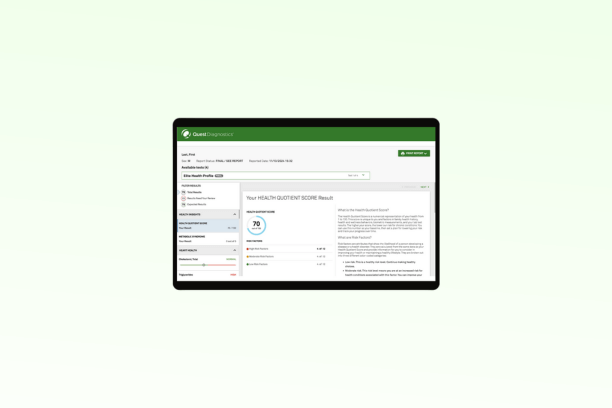
Quest Health provides access to diagnostic tests intended to give an understanding of general fitness and specific concerns. The platform offers a wide range of lab tests and test panels across multiple categories, such as allergy screening, sexual health, hormones, vitamin/nutrient deficiencies, thyroid, and fitness.
Options include individual tests, bundled health profiles, and both in-person and at-home collection methods, depending on the test type. It also provides access to online result delivery, FSA/HSA eligibility for many tests, and the option to discuss results with an independent physician after testing.
This review will examine the platform’s test offerings, ordering and sample collection process, result reporting, and physician follow-up options. It also explores the real user experiences with the platform’s services and testing accuracy.
About Quest Health
Developed by Quest Diagnostics, Quest Health provides direct access to clinical lab work without requiring a prior doctor visit for purchase.
As per its official website, the platform offers access to more than 100 laboratory tests that are performed in CLIA-certified Quest Diagnostics laboratories.
The platform follows a structured process that begins with online test selection and purchase through its official website. After purchase, tests must be registered, and an appointment is scheduled, typically at one of more than 2,000 Quest Diagnostics centers across the United States. Depending on the test, sample collection may occur at the assigned service center, through in-home sample collection via Quest Mobile™, or using at-home test kits. Once samples are collected and analyzed, results are delivered online and become accessible through the brand’s online portal.
Testing categories cover areas such as general health, women’s health, men’s health, sexual health, hormones, and specialty screening. Some featured panels include the Elite Health Profile, which measures over 85 health markers. The Comprehensive Health Profile panels assess more than 75 biomarkers related to metabolic, cardiovascular, hormonal, liver, kidney, and immune function.
The platform also provides various individual and condition-focused tests, such as Complete Blood Count Test, Comprehensive Metabolic Panel Test, Cholesterol Panel, Hemoglobin A1c Test, Vitamin D Test, Testosterone Test, and Thyroid TSH Function Test. Additional offerings cover autoimmune screening, drug screening, pregnancy testing, hormone panels, nutrient level testing, and inflammation markers such as hsCRP.
According to its official website, all results are overseen by an independent physician, and each test order is authorized accordingly. Access to a physician consultation to review results is included at no additional cost.
Quest Health Offerings
-
Lab Tests Online
Quest Health’s Lab Tests allows you to purchase lab tests directly without a prior doctor visit, providing access to more than 150 clinically validated blood, urine, and specialty tests covering general health, chronic disease risk, hormones, sexual health, and allergy screening.
The scientific foundation of this segment is based on standardized clinical pathology. For instance, tests such as the Complete Blood Count (CBC) quantify red blood cells, white blood cells, and platelets to evaluate oxygen transport, immune activity, inflammation, anemia, and hematologic disorders.
The Comprehensive Metabolic Panel (CMP) measures 14 biochemical markers, including glucose, electrolytes, liver enzymes, and kidney filtration markers, offering insight into metabolic health, renal clearance, hepatic function, and systemic electrolyte balance.
As per the official website, cardiometabolic risk assessment is supported through lipid and glucose testing. For example, the Cholesterol (Lipid) Panel measures total cholesterol, LDL, HDL, triglycerides, and calculated ratios that reflect lipid transport, arterial plaque risk, and reverse cholesterol transport.
Elevated LDL and triglycerides are typically associated with atherosclerosis, while HDL plays a protective role by returning excess cholesterol to the liver. The Hemoglobin A1c Test evaluates long-term glucose exposure by measuring glycation of hemoglobin, providing an integrated view of blood sugar control over approximately three months rather than a single time point.
Hormonal and endocrine testing screens for regulatory systems that influence metabolism, energy, reproduction, and stress. The Thyroid TSH Function Test measures pituitary signaling to the thyroid gland, with reflex T4 testing to clarify hypo- or hyperthyroid states. As thyroid hormones regulate basal metabolic rate, cardiovascular function, neurological activity, and lipid metabolism, abnormal TSH values may have multi-system consequences.
Additional offerings from the platform include the Chlamydia & Gonorrhea Test, Comprehensive Health Profile Men’s/Women’s, Autoimmune Screening Test (ANA with Reflex), Measles, Mumps, Rubella (MMR) Test, and Trichomoniasis Test.
Such tests are performed at Quest Diagnostics centers or via eligible at-home collection kits, using validated laboratory methods and reference ranges. An independent physician service fee supports clinical oversight through affiliated providers such as PWNHealth, who review results and contact when findings require timely attention. Results are delivered through the secure MyQuest portal with clear explanations.
Quest Health Advantages
-
Legacy Laboratory Brand Identity
Quest Health is built on the legacy of Quest Diagnostics, a laboratory organization with more than 50 years of history dating back to its founding in 1967.
The brand’s identity represents a long-standing focus on scalable, standardized laboratory processes designed to support clinical care beyond inpatient settings.
Its operational history includes the generation and analysis of more than 56 billion patient data points over decades of testing. The scale reflects sustained experience with high test volumes, complex laboratory workflows, test validation, and result interpretation, forming the analytical foundation that Quest relies on for consistency across its testing panels.
Clinical oversight further reinforces this foundation. Board-certified pathologists, laboratory directors, and medical leadership oversee testing methodologies, quality controls, and result reporting across the organization. Figures such as Yuri Fesko, Senior Vice President and Chief Medical Officer at the brand, reflect the level of medical leadership involved in guiding test development and clinical relevance.
-
Large-Scale Laboratory Operations
The brand draws on the large-scale operational infrastructure of Quest Diagnostics, which supports testing for millions of people each year across a nationwide network of more than 7,100 patient access points, including laboratories and collection sites.
Such a large scale supports relatively fast turnaround times for many commonly ordered tests, as samples move through established, high-capacity laboratory facilities rather than smaller or fragmented labs. Standardized workflows, automation, and long-standing logistics systems coordinate specimen transport, processing, and reporting at volume, allowing results to be delivered through secure digital channels without relying on ad hoc handling.
Operating at this level also places privacy and data protection as core requirements. Enterprise-grade systems developed for clinical laboratory environments are used to manage personal health information, where confidentiality and data security are considered as foundational to daily operations rather than optional features.
Quest Health Limitations
-
Billing Frustrations Reported
User reviews on independent platforms report that Quest Health’s Lab Tests and related services have concerns around billing, particularly when charges appear unexpectedly or when insurance handling becomes complicated.
Common concerns centered on surprise bills that differ from initial price estimates, charges that surface after insurance adjudication, and cases where the amount billed did not match what users expected based on the listed self-pay pricing.
As lab diagnostics involve CPT codes, insurance claim processing, and cross-billing between providers and labs, users have sometimes noticed double charges (one from the ordering service and another from the laboratory) or mismatches between pre-authorization estimates and actual insurer payments.
Such experiences lead to resolution delays, where you may spend additional time clarifying what portion of a lab test should be paid by insurance versus out-of-pocket, negotiating adjustments, or requesting corrected claims submissions. Such complexity might be frustrating if you are expecting a smooth online health service experience.
-
Limited Home Collection Options
Quest Health provides relatively few home collection options, which may influence convenience when ordering tests through its Lab Tests. One primary at-home option is Quest Mobile, an in-home sample collection service where a mobile phlebotomist visits the home to collect specimens. The service is generally offered as a paid add-on and is not included in standard test pricing.
Availability for in-home collection is limited by both location and test type. Selected tests must be added to the cart and taken through checkout to determine whether the Quest Mobile option appears, as eligibility depends on geographic coverage and logistical constraints. When the option is unavailable, collection requires a visit to a physical Quest Diagnostics location or the use of a mail-in collection kit when that option is offered.
Pros
- Offers a range of telehealth services focused on preventive and chronic care areas, such as sexual health, allergy screening, sexual health, and nutrient deficiencies.
- Maintains a nationwide network of 2,000+ Quest Diagnostics centers, alongside in-home collection and limited at-home kits for convenience.
- Prepaid model avoids insurance billing issues, while also accepting FSA/HSA payments and financing via Klarna/Affirm.
- Offers a user-friendly MyQuest app for purchasing tests, scheduling collection, and tracking results.
Cons
- Lack of insurance reimbursement may contribute to increased out-of-pocket costs.
- The multi-step process after purchase (register, schedule, collect) may feel cumbersome for some users despite its simplicity.
Quest Health Alternatives
-
myLab Box
myLAB Box and Quest Health operate in the diagnostic testing space, but they approach access, testing scope, and care delivery from structurally different models. The myLAB Box brand was built specifically as an at-home, mail-in testing platform with no requirement for clinic visits, insurance, or in-person sample collection. Its identity is closely tied to privacy, autonomy, and convenience, with all kits shipped discreetly to the home and returned by mail to CLIA-certified and CAP-accredited laboratories.
Quest Health emphasizes clinical credibility and breadth by leveraging professional collection at more than 2,000 collection centers, optional mobile phlebotomy, and select home collection kits depending on the test.
myLAB Box’s featured test offerings are organized around condition-focused panels intended for self-collection. Sexual health is one of the brand’s prominent categories, featuring panels such as the Uber Box eight-panel STD test and the Total Box fourteen-panel STD test, which bundle multiple bacterial and viral screenings.
Women’s Health and Fertility panels measure hormones including testosterone, estradiol, progesterone, cortisol, DHEA, LH, FSH, thyroid hormones, and thyroid antibodies, while men’s hormone testing focuses on testosterone, cortisol, estradiol, and DHEA. Fertility-specific offerings extend into sperm count testing, ovarian reserve screening, ovulation confirmation, and female fertility hormone panels.
Meanwhile, Quest Health’s catalog is broader in absolute marker count and mirrors traditional clinical testing options rather than curated test bundles.
Entry-level tests include basic options such as testing for Complete Blood Count, Magnesium, Hemoglobin A1c, Blood Type, and Metabolic Markers.
The platform’s portfolio extends to cholesterol panels, thyroid function tests, testosterone testing, vitamin status, inflammation markers, and STD screening. It also features comprehensive profiles such as the men’s and women’s health panels covering roughly seventy-five biomarkers and the Elite Health Profile measuring more than 85 indicators across cardiometabolic, inflammatory, immune, hormonal, liver, and kidney systems.
Preventive and wellness testing also diverges in structure between the two platforms. myLAB Box emphasizes lifestyle- and goal-oriented testing such as adrenal stress, sleep and circadian rhythm hormones, metabolism, anti-aging panels, skin vitality testing, and food sensitivity panels across multiple food counts, and indoor and outdoor allergy tests.
Quest Health’s preventive testing segment remains more firmly structured to advanced heart health panels, autoimmune screening, tuberculosis testing, drug screening, and nutritional assessments.
Post-test support represents another key difference. myLAB Box includes complimentary telemedicine consultations with licensed physicians when results are positive for reportable or actionable conditions, enabling explanation, guidance, and prescription routing to local pharmacies when appropriate.
Quest Health similarly provides digital results in clinical report formats and offers optional physician review at no additional cost, but positions this support as interpretive rather than as an integrated condition management pathway. Follow-up care is typically routed back to your existing healthcare provider.
-
Everlywell
Everlywell functions as a laboratory testing platform designed around health monitoring, proactive insight, and at-home convenience rather than traditional diagnostic care. Its ecosystem is organized around goal-oriented testing that is largely completed through mail-in kits.
Some signature test offerings from the brand include the At-Home Food Sensitivity Test and Comprehensive Food Sensitivity Test, which are based on IgG antibody reactivity, available in standard formats covering fewer than one hundred foods and comprehensive versions covering more than two hundred foods. Hormone health represents another range, with women’s hormone panels measuring eleven biomarkers tied to reproductive, adrenal, and metabolic function.
Other test offerings provided by the platform include the Metabolism Test, Thyroid Test, Testosterone Test, Heart Health Test, Chlamydia & Gonorrhea Test, HbA1c Test, Vitamin D & Inflammation Test, and Hepatitis C Test. Sample collection for Everlywell is centered on at-home collection, relying on dried blood spot cards, saliva, urine, swabs, and stool samples validated for mail-in testing and processed through CLIA-certified laboratories, with some also CAP-accredited. Select offerings expand beyond the home collection model, including in-person lab testing options and the Galleri multi-cancer early detection blood test.
Quest Health operates from a fundamentally different foundation, functioning as an extension of Quest Diagnostics’ established clinical laboratory network. The platform highlights that accuracy, clinical depth, and alignment with physician-ordered workflows are its primary priorities.
The brand’s catalog covers a wide range of clinical diagnostics organized by test complexity rather than lifestyle goals. Some featured offerings include the Complete Blood Count Test, Hemoglobin A1c Test, Comprehensive Metabolic Panel Test, Cholesterol Panel, Vitamin D Test, and Testosterone Test.
Higher-complexity diagnostics include expanded STD panels, autoimmune screening, advanced heart health panels, tuberculosis testing, and drug screening.
Testing logistics represent a clear point of distinction. Quest Health relies primarily on professional sample collection at various Quest centers nationwide, with mobile phlebotomy available in select regions and limited home collection kits depending on test type. Such a collection model may support higher test complexity, confirmatory accuracy, and reduced collection error, but requires physical attendance for most tests.
How Did We Evaluate?
-
Real User Reviews
In evaluating the brand, we analyzed its real user feedback on Trustpilot, where the brand currently holds a 1.6 out of 5 rating from 1,300+ reviews.
Many users shared problems with billing, including claims of double charging, collection notices despite prior payment, and invoices that were difficult or impossible to understand.
A repeated complaint is the near absence of accessible customer support, with some users describing excessive reliance on automated systems, and months-long attempts to resolve basic billing or insurance questions without success.
Operational and logistical issues appear frequently in negative feedback as well. A few users described long wait times, canceled or mishandled appointments, confusing or inconsistent rules across locations, and difficulties obtaining test results promptly. Several reviews highlight app and identity verification problems, delayed or invalid test results, and contradictory instructions that led to unusable specimens.
Although limited, positive feedback was highly location-specific and staff-driven. Favorable reviews often praised individual phlebotomists or lab teams for professionalism, kindness, and technical skill, especially in difficult blood draws. A few users reported efficient check-in experiences, short wait times, and smooth visits.
Our evaluation indicates that the brand’s user feedback is impacted by widespread dissatisfaction with billing practices, customer service access, and operational consistency, which outweighs the positive experiences reported at individual labs.
-
Brand Reputation
To evaluate the brand, we looked at the background and presence of Quest Diagnostics (parent company) across independent review forums, with an emphasis on brand reputation signals rather than product breadth or clinical claims.
On ConsumerAffairs, the brand holds a 1.3 out of 5 score based on 800+ reviews. The large review volume suggests sustained consumer engagement, but sentiment trends mostly negative.
Some positive feedback highlighted individual phlebotomists, noting professionalism, skill with difficult blood draws, and courtesy in-person interactions at specific locations. Meanwhile, the majority of negative reviews focus on billing errors, delayed or missing test results, confusing or broken online portals, poor customer service responsiveness, and appointment scheduling failures.
TenereTeam rated the brand with a 4.7 out of 5 score based on 1,800+ ratings. Many users highlighted a user-friendly experience with purchasing test kits, the platform’s wide range of over 100 tests, and the convenience of fast access to results. However, a few users noted limited in-person support and long wait times to schedule appointments.
The platform appears to be appreciated for its national scale, extensive test availability, and a broad physical footprint. However, there are also persistent complaints related to administrative reliability, billing transparency, and turnaround times.
Frequently Asked Questions
- Does Quest Health guarantee consistent result turnaround times?
No. The brand does not guarantee fixed turnaround times. Result turnaround time may vary by test type. The brand advises checking the After the test section on individual test detail pages for expected result times, confirming no uniform guarantee across tests. - Does Quest Health offer specialized panels?
Yes. The platform offers condition-specific panels, including autoimmune panels for conditions like rheumatoid arthritis, lupus, and Sjögren’s syndrome, plus infectious panels for viral and bacterial infections. - Can Quest Health results conflict with a clinician’s assessment?
Yes, it is possible. Quest Health results may differ from a clinician’s assessment due to lab reference range differences, testing variability, or interpretation context. A result flagged as abnormal may be considered normal by another healthcare provider or clinician.
Conclusion
Quest Health functions as a long-established lab testing service supported by the clinical infrastructure of Quest Diagnostics.
The platform allows you to purchase lab test packages without a prior doctor visit through a prepaid model that emphasizes standardized testing, fast turnaround, and access to CLIA-affiliated laboratories.
However, the platform does not provide insurance reimbursement for its services, so repeat testing or multiple panels may increase your total medical expense. Home collection options are also limited, as the platform’s main at-home offering is Quest Mobile, which usually adds to extra costs.
Before opting for Quest Health, it is worth considering how often testing will be repeated, whether travel to a physical collection site is practical, and whether home collection fees affect the total cost and your budget.

Rachel has been a freelance medical writer for more than 18 years. She graduated from the University of Tennessee at Knoxville in 2005 and is currently practicing as a Certified Registered Nurse Anesthetist at a Level I trauma center.
Leave a Reply