

No products in the cart.
Contents
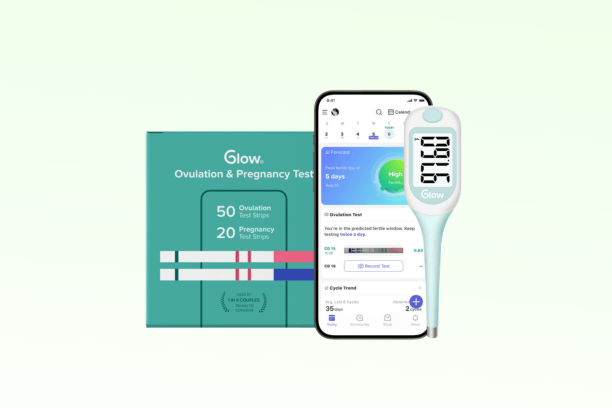
Glow is a women’s health platform that combines fertility tracking, pregnancy support, and early parenting tools within a connected digital ecosystem. It offers a range of mobile applications designed to help you monitor and understand different stages of reproductive and maternal health, including cycle tracking, baby care logging, and period management.
In this review, we cover some of the brand’s core offerings and provide a comparison with similar brands. We also assess the brand’s advantages along with potential limitations to provide a detailed analysis.
About Glow
Glow claims to help you better understand and manage different stages of reproductive health. The company was co-founded by Max Levchin and uses data to provide personalized insights related to ovulation, menstruation, pregnancy, and general wellness.
The platform offers AI-assisted wellness support through GlowGPT while emphasizing privacy tools and offline data protection. Its offerings include apps such as Ovulation Tracker, Nurture Pregnancy Tracker, Baby Tracker, and Eve Period Tracker. The brand also extends into physical health products such as the Wearable Breast Pump, Basal Thermometer, Ovulation Test Strips, and Pregnancy Test Strips.
Core Offerings
-
Glow Smart Basal Thermometer
The Smart Basal Thermometer helps you monitor basal body temperature patterns associated with ovulation. It works with the Ovulation Tracker and Eve Period Tracker apps, where temperature readings can be synced and analyzed alongside other logged health data. Basal body temperature refers to the body’s resting temperature immediately after waking, which may shift slightly after ovulation because of hormonal changes during the menstrual cycle.
The thermometer connects to Glow’s app ecosystem through Bluetooth integration. It works alongside features such as cycle charts, ovulation forecasting, symptom logging, and historical trend tracking to support fertility monitoring.
-
Fertility Test Kits
The Fertility Bundle combines ovulation test strips, pregnancy test strips, a smart basal thermometer, and a one-year premium subscription to support fertility tracking and conception monitoring.
The ovulation test strips measure luteinizing hormone (LH) levels through urine testing. Since LH levels typically rise before ovulation, tracking these changes may help identify the most fertile days in the menstrual cycle.
The pregnancy test strips help detect early pregnancy by measuring human chorionic gonadotropin levels in urine samples. The included Smart Basal Thermometer supports ovulation monitoring through basal body temperature tracking and charting.
-
Glow Smart Breast Pump
Glow Smart Breast Pump is a wearable, app-connected breast pump intended to support milk expression through hands-free pumping and digital session tracking. The device may allow you to pump while moving around, performing household tasks, or remaining away from a stationary setup. It combines wearable pump hardware with Bluetooth connectivity and integration with the Glow Baby app, where pumping sessions, milk volume, and timing data can be tracked automatically.
The pump includes four operating modes identified as stimulation, expression, massage, and auto mode. These modes may allow you to adjust pumping patterns according to comfort preferences or different stages of milk expression. The device also includes 12 suction levels with a maximum suction strength of 300 mmHg.
-
Digital & AI-Powered Services
Glow offers mobile apps and AI-based tools focused on fertility, pregnancy, menstrual tracking, and parenting support. You can log details like cycle dates, symptoms, mood changes, pregnancy progress, and baby routines to receive personalized insights and predictions. Its AI chatbot answers questions related to reproductive health, pregnancy, and infant care while adjusting responses based on user activity over time. The platform also uses predictive algorithms to identify patterns connected to ovulation, fertility windows, cycle changes, and pregnancy timelines across its different tracking apps.
Glow Advantages
-
Integrated Reproductive Care Ecosystem
Glow structures around a connected reproductive-health ecosystem designed to support you across multiple life stages. The company organizes its platform through interconnected apps, including Eve for period and sexual health tracking, Glow for fertility and conception tracking, Nurture for pregnancy support, and Glow Baby for infant care and feeding management.
The brand also offers connected hardware and product integration. Devices and products available through the Glow Shop, including basal thermometers, ovulation-related tools, and breast-pumping products, are integrated into the platform’s tracking architecture to support automated or simplified health-data entry across fertility and postpartum workflows.
The brand claims to develop a more unified feature-access model tied to forecasting tools, tracking insights, and expanded data analysis throughout different reproductive stages. This continuity can make the transition between fertility tracking, pregnancy, and postpartum support feel more organized by keeping your health history, tracking data, and monitoring tools connected within a single ecosystem.
-
Predictive Reproductive Health Intelligence
Glow highlights data-driven reproductive-health personalization. The company states that it draws from a large reproductive-health dataset spanning millions of users and billions of tracked data points, which the platform uses to generate predictive insights, personalized forecasts, and comparative reproductive-health analysis across fertility, menstruation, pregnancy, and postpartum tracking. It analyzes logged behaviors, symptoms, cycle patterns, biometrics, and reproductive-health trends against broader population-level datasets to estimate fertile windows, ovulation timing, period timing, symptom patterns, pregnancy-related changes, and broader cycle-related trends.
The brand also highlights AI-supported health interaction, which provides personalized responses based on user-tracked data, reproductive-health context, and platform-level informational systems. It generates tailored recommendations, reminders, fertility insights, cycle-phase guidance, and pregnancy-related support from tracked reproductive-health patterns and logged behaviors. This structure may help you monitor reproductive-health patterns with more personalized forecasting over time.
Glow Limitations
-
Documented History of Security Failures
Glow has faced multiple publicly documented privacy and security incidents involving highly sensitive reproductive-health data, creating a significant long-term trust and data-protection concern around the platform.
Between 2013 and 2016, the California Attorney General’s Office alleged that Glow maintained security flaws that exposed user information and improperly handled account-sharing permissions. One major issue involved the app’s Partner Connect feature, where account-linking requests could reportedly be approved automatically without proper authorization from the second user whose reproductive-health data would be shared.
More recently, another security incident reportedly exposed data tied to roughly 25 million users through a vulnerability in Glow’s online forum API. Public reporting around the incident stated that exposed information included names, age-group data, location details, unique identifiers, and user-uploaded images before the issue was patched.
You should be aware that Glow collects among the most sensitive categories of personal health data that exist, including abortion history, fertility test results, and sexual activity logs, and the platform has a documented track record of failing to secure this data adequately across multiple distinct incidents.
-
App Suite Cross-Sync Limitations
The Glow app is explicitly intended as an aid in ovulation prediction to facilitate conception and is not to be used for contraception. Eve and Glow do not sync with each other, requiring you to add and edit data twice, and resulting in divergent analyses if any entry is missed in one app. The lack of cross-app data synchronization is structurally significant because the platform’s value proposition is a continuous journey across multiple life stages. It creates the appearance of an integrated system without the underlying data infrastructure to support it. Independent reviews highlight that users describe the experience as completely unfair and frustrating.
You may encounter a situation where your cycle history in one app does not carry over to another, forcing manual duplication of logging and potentially producing conflicting fertility predictions from apps that are nominally part of the same platform.
Glow Alternatives
-
Proov Test
Proov and Glow both operate within the fertility and women’s health category, but they are structured around very different models. As per its official website, Proov is primarily built around hormone testing, fertility analysis, and hormone-support products. Meanwhile, Glow functions more as a reproductive health tracking platform centered on mobile apps, predictive cycle monitoring, pregnancy support, and parenting tools. Proov focuses on hormone imbalance detection, ovulation confirmation, and fertility-related biomarkers, whereas Glow places greater emphasis on menstrual tracking, fertility calendars, baby-care logs, reminders, and app-based health organization across multiple life stages.
The way both brands establish credibility also differs. Proov centers its identity around founder Dr. Amy Beckley, a PhD scientist. The brand repeatedly references its PdG testing system, AI-based pattern recognition technology, and database containing over 3 million datapoints used to analyze hormone shifts, cycle patterns, and symptoms. It also highlights a clinical study linking sustained elevated PdG levels during the implantation window with higher pregnancy rates. In comparison, Glow takes a more technology-driven approach by focusing on app analytics, comparative health insights, advanced charting, predictive fertility windows, and AI-assisted guidance.
Their product ecosystems reflect these differences clearly. Proov’s catalog includes fertility testing systems, PdG ovulation confirmation kits, hormone trackers, sperm motility tests, prescription consultation services for medications, fertility coaching, and several hormone-support formulas. Products such as the Balance Supplement Bundle, Pro Implantation Supplement Support, and Empower Perimenopause Test Kit are positioned around fertility support, implantation, hormone balance, and perimenopause symptom management. Meanwhile, Glow’s ecosystem is more app-centered and consumer-tech focused. Its products mainly include ovulation and pregnancy test strips, a basal thermometer integrated with the Glow app, and a wearable breast pump connected to the Glow Baby app. Glow Premium expands the digital side of the platform by adding comparative insights, advanced analytics, health forecasts, and daily health plan access across all four apps.
Proov personalizes your experiences using hormone readings, cycle analysis, symptom tracking, and ovulation scoring tied to measurable biological markers. It identifies subtle hormone shifts linked to infertility or hormone imbalance symptoms and then generates tailored recommendations and supplement suggestions. Glow’s personalization relies on user-entered data, predictive algorithms, and long-term behavioral tracking. Features such as advanced charting, comparative analytics against similar users, cycle forecasting, and AI-generated guidance are designed to help you interpret reproductive patterns without direct hormone testing. Unlike Proov, Glow’s system does not center around biomarker validation or hormone-specific diagnostics.
Proov provides hormone testing, fertility diagnostics, supplements, and guided fertility support to help you identify possible hormone-related fertility issues. Glow takes a broader app-based approach that helps you track cycles, manage reproductive health information, access parenting support, and receive AI-based insights across different stages.
-
TempDrop
Tempdrop is centered around a wearable fertility sensor and companion charting app that focuses on basal body temperature tracking during sleep. Its platform is designed around fertility-awareness methods, ovulation confirmation, and cycle interpretation through physiological monitoring. Glow, in comparison, functions as a broader digital health ecosystem that combines fertility tracking, pregnancy support, AI-supported analytics, and connected health products through multiple apps and subscription services. While Tempdrop concentrates on fertility-specific monitoring, Glow extends its platform into several stages of reproductive health and parenting.
Tempdrop’s system revolves around overnight temperature monitoring through an upper-arm wearable sensor. You are instructed to wear the device before sleep, leave it on throughout the night, and sync the collected data with the app later in the day. The company states that the sensor continuously measures core body temperature using multiple sensors and applies patented Active Temperature-Noise Cancellation filtering alongside a learning algorithm that adapts to individual nightly and monthly temperature patterns. Glow’s fertility-tracking approach depends more heavily on app-based data logging and cycle prediction tools. It highlights that its Ovulation Tracker app displays fertile windows, follicular phases, luteal phases, ovulation calendars, reminders, and symptom tracking features directly within the app interface.
The scope of both ecosystems also differs significantly. Tempdrop remains focused on fertility tracking and cycle interpretation. Its platform includes wearable temperature tracking, ovulation confirmation, symptom logging, sleep-stage analysis, and educational content through Tempdrop Academy. Meanwhile, Glow operates on a much broader structure through Glow Ovulation Tracker, Glow Nurture, Glow Baby, and Eve by Glow apps.
The subscription models reflect these structural differences. Tempdrop Premium primarily enhances the wearable fertility-tracking experience by expanding interpretation tools and cycle analytics connected to temperature monitoring. Its additional features remain closely tied to fertility-awareness methods and physiological tracking. Glow Premium functions more like a unified software subscription across all apps. The membership includes advanced charting, comparative insights, health forecasts, premium articles, daily health plans, premium support, profile customization, and ad-free access. The brand also promotes a 7-day free trial followed by an annual subscription model.
Tempdrop is focused on passive overnight biometric tracking, ovulation confirmation, and fertility-awareness methods, whereas Glow functions as a broader reproductive health and parenting ecosystem.
Pros
- Supports different life stages through multiple apps.
- Uses AI to address women’s health.
- Covers both menstruation and parenting needs.
Cons
- Access to most features requires an annual subscription.
- Users report inconsistent performance in third-party reviews.
Real User Experiences
To evaluate Glow, we analyzed recent user feedback from its app store reviews, focusing on long-term usability, tracking reliability, subscription practices, interface design, and user satisfaction. The app currently holds a 4.0-star rating based on more than 72,000+ reviews.
Many users mentioned considering Glow for cycle tracking, fertility monitoring, pregnancy logging, and postpartum data organization. Several customers mentioned that the app was previously considered accurate, simple to navigate, and useful for identifying cycle patterns over extended periods. Users who tracked pregnancies or irregular cycles often appreciated the amount of reproductive health information the app could store and organize.
However, multiple users reported that features previously available for free are now locked behind premium subscriptions. They frequently mentioned excessive pop-ups, repeated upgrade prompts, and advertisements appearing during basic actions such as opening the calendar or recording symptoms. Some customers stated that the free version now feels limited to basic period tracking, while more detailed insights and historical data access require payment.
Ease of use was another major factor in our evaluation. Several users described the interface as cluttered and less intuitive than earlier versions. Some users felt the app had shifted away from being a straightforward cycle tracker toward a broader wellness and discussion platform, which reduced usability.
Based on this feedback, Glow may retain value if you want extensive reproductive health tracking and long-term data management. However, you may feel the app has become less accessible and streamlined compared to earlier versions. It may be worth checking your historical entries regularly and keeping separate records of important reproductive health data. You should also expect frequent upgrade prompts and limited functionality within the free version, particularly if you rely on detailed insights, symptom tracking, or older cycle history.
Conclusion
Glow combines symptom logging, predictive tracking algorithms, and medical advisory involvement to support its data-driven positioning. Its platform reflects the broader shift toward digital reproductive health tools that use continuous data collection to identify patterns associated with ovulation, menstrual cycles, and fertility trends.
However, the reliability of app-generated insights still depends heavily on consistent data input and individual biological variability, which can affect predictive accuracy. Cross-sync limitations between apps within the ecosystem may create inconsistencies in data integration and reduce continuity between services.
Before considering the platform, you may benefit from reviewing privacy permissions carefully, limiting unnecessary data sharing within community features, and avoiding reliance on app-generated fertility predictions as a substitute for professional medical guidance.
Glow presents a broader and more research-oriented reproductive health ecosystem, though its history of security concerns and platform integration limitations remain important considerations.

Rachel has been a freelance medical writer for more than 18 years. She graduated from the University of Tennessee at Knoxville in 2005 and is currently practicing as a Certified Registered Nurse Anesthetist at a Level I trauma center.
Leave a Reply