

No products in the cart.
Contents
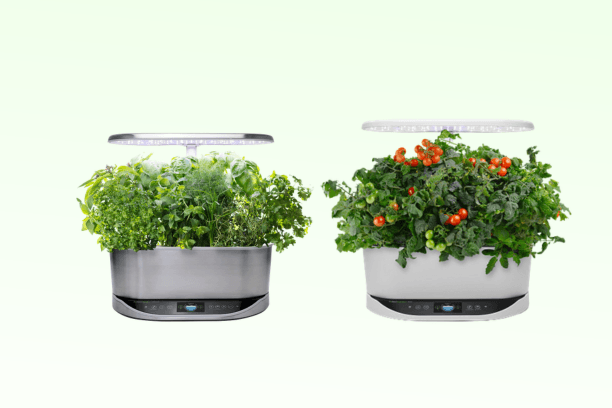
AeroGarden develops hydroponic growing systems for herbs, vegetables, flowers, salad greens, and small fruiting plants. The brand focuses on compact, soil-free gardening setups designed for indoor use, with product lines ranging from small countertop units to larger smart garden systems. It aims to offer simplified gardening options for apartments, small homes, or environments with limited outdoor growing space and inconsistent sunlight exposure.
In this review, we will examine AeroGarden’s product range, indoor gardening systems, and supporting accessories while exploring the brand’s potential advantages. We will also look at common complaints, broader concerns surrounding maintenance requirements, and user experience.
About AeroGarden
Owned by ScottsMiracle-Gro and originally started in Boulder, Colorado, AeroGarden offers a product ecosystem that includes hydroponic garden systems, seed pod kits, grow lights, and gardening accessories. Its garden systems are available in multiple sizes and configurations, including product lines such as Harvest, Harvest Elite, Bounty, Bounty Basic, and Bounty Elite. As per the official website, the brand also provides products such as seed pod kits, including the Gourmet Herbs Seed Pod Kit.
AeroGarden Offerings
-
Indoor Garden Systems
Indoor garden systems include compact hydroponic countertop systems like the Sprout and Harvest, alongside larger models such as the Bounty, Bounty Elite, Harvest XL, and Harvest Elite 360 that are built to support higher plant capacity and taller growth. The smaller systems, including the Sprout and Sprout with Gourmet Herb Seed Pod Kit, are positioned for basic indoor herb growing and entry-level use. They might help reduce stress and improve emotional comfort by making indoor spaces feel more attractive and calming.
Harvest series, including Harvest Lite, Harvest Elite, and Harvest Elite 360, expands the growing space with multiple pod slots, combined LED grow lights, and adjustable lamp heights. The Bounty and Bounty Elite systems help grow larger vegetables, leafy greens, or multiple plants simultaneously, with increased grow height support compared to the compact models.
-
Seed Kits
Seed Kits are personalized for specific plant varieties and compatible models. The brand offers a range of options depending on what you want to grow. Herb-focused kits include the Gourmet Herbs Seed Pod Kit, Pesto Basil Seed Pod Kit, and International Basil Seed Pod Kit.
Meanwhile, its vegetable-oriented options include Sweet Banana Pepper, Heirloom Cherry Tomato, and Mighty Mini Cherry Tomato Seed Pod Kits. For leafy greens, the Mixed Romaine Seed Pod Kit focuses on salad-style indoor growing.
As per the official website, the brand also includes more flexible systems, such as the Grow Anything Seed Pod Kit, which allows you to insert your own seeds instead of using pre-selected varieties. The range also features Seed Starting Systems for Harvest and Bounty models, which are designed to help you germinate seedlings indoors before transferring them outdoors or into larger containers.
-
Grow Lights
Grow lights help indoor plants receive consistent light exposure even when natural sunlight is limited. The brand’s Stem Grow Light is built for compact indoor spaces and can support small plants placed in darker corners, desks, shelves, or apartments where window access may be inconsistent. The setup uses stabilizing prongs that insert directly into the soil, reducing the need for separate stands or bulky mounting systems.
According to the official website, the Stem Grow Light includes a 5W LED system and supports plants up to 10 inches tall. Its adjustable arm can extend from 7 to 14 inches. This allows you to position the light closer to the seedlings or raise it as plants grow. The brand also added four lighting modes, including full-spectrum, white, warm, and cool settings.
The grow light also connects with the AeroGarden app, where you can unlock additional smart controls and customization features. This app-based functionality may help you manage lighting preferences more precisely instead of relying only on manual adjustments.
AeroGarden Advantages
-
Integrated Hydroponic System Architecture
AeroGarden structures its product ecosystem around countertop hydroponic gardens designed to automate many of the core functions involved in indoor growing. The systems combine water-based growing chambers, integrated LED lighting, preset light cycles, liquid plant nutrients, and automated reminders for feeding and watering into a single guided growing environment.
The company positions this architecture as a simplified alternative to traditional soil gardening. According to AeroGarden, the systems are designed to grow plants without soil, direct sunlight, herbicides, pesticides, or GMO seeds, while hydroponic growth conditions can accelerate plant growth rates to as much as five times faster than conventional soil cultivation under certain conditions. You may find the brand easier to use than assembling separate grow lights, nutrient systems, containers, pods, and seed kits from multiple suppliers. It helps keep your setup, feeding schedules, replanting, and routine maintenance inside one connected system.
-
Established Parent-Company Backing
AeroGarden operates within the broader ScottsMiracle-Gro corporate portfolio, giving the brand access to a much larger consumer-garden infrastructure than many standalone indoor-growing startups. ScottsMiracle-Gro positions itself as a major North American lawn-and-garden company, with AeroGarden serving as one of its primary indoor-growing and hydroponic consumer brands. That parent-company backing supports broader operational continuity across fulfillment, customer support, accessories, seed-pod replenishment, warranty systems, and product servicing. The company publicly reaffirmed ongoing support for the platform, including continued availability of gardens, accessories, replacement components, and seed-pod inventory.
The company also maintains product-specific support protections tied to authorized purchases. AeroGarden states that official products include a 90-day seed-pod germination guarantee alongside a dedicated one-year limited warranty covering hardware defects and workmanship issues for qualifying garden systems. This structure creates an institutionally supported indoor-gardening ecosystem. You may find this useful if long-term ecosystem stability, replacement-part availability, centralized customer support, and ongoing product continuity are important factors in choosing an indoor hydroponic gardening system.
AeroGarden Limitation
-
Partial Smart-Feature Coverage
AeroGarden’s smart features do not apply across the entire brand. The app support described by the company is limited to specific Bounty and Farm generations, selected classic devices, and certain AeroGarden grow lights. The brand also notes that some pre-2019 Harvest, Bounty, and Farm units are not compatible with the new app because of outdated security firmware.
The brand’s current software environment requires a newer app and newer firmware standards, and the company states that the old and new apps cannot function at the same time. It also says affected gardens remain usable without app support, which confirms that connectivity is optional and model-dependent across the brand portfolio.
The brand has two partially overlapping product ecosystems. Newer connected gardens support app-based controls, remote monitoring, and smart-home integrations, and older or legacy models operate primarily through local onboard controls without ongoing connected-platform functionality. You should verify the exact model and hardware version before assuming Wi-Fi connectivity, mobile-app access, voice-assistant integration, or long-term smart-feature support.
AeroGarden Alternatives
-
Mufga
As per its official website, Mufga primarily concentrates on compact hydroponic systems designed for indoor cultivation, with most of its catalog centered around pod-based growing units. These include LED grow lights, water circulation pumps, and adjustable growing structures. AeroGarden, in comparison, presents a broader indoor gardening catalog that includes garden systems, Seed Kits, Grow Lights, and accessories, alongside support resources combined into its storefront.
Mufga’s lineup is limited to hydroponic growing units such as the 8 Pods Indoor Herb Garden Kit, 12 Pods Indoor Gardening System, and 18 Pods Indoor Gardening System. These systems are repeatedly described with functional specifications including height-adjustable grow lights, water circulation pumps, modular tray structures, and hydroponic nutrient delivery systems. The 18-pod model specifically mentions adjustable lighting up to 17.7 inches to support plants at different growth stages. The brand also repeatedly references the ability to grow herbs, leafy greens, vegetables, flowers, and small fruiting plants indoors throughout the year. Meanwhile, AeroGarden’s product range is broader and more segmented into multiple product categories. It highlights systems such as the Bounty Elite, Bounty, Harvest Elite, Bounty Basic, and Harvest, while also featuring products like the Gourmet Herbs Seed Pod Kit and separate grow light accessories. Unlike Mufga, AeroGarden places a stronger emphasis on ongoing seed pod usage and accessory integration within the gardening setup.
The two brands also differ in how much attention they give to hydroponic system mechanics. Mufga focuses on technical functionality such as full-spectrum LED grow lights, hydroponic circulation systems, self-watering operation, nutrient reservoirs, and intuitive control panels. However, AeroGarden offers fewer operational details related to hydroponic engineering. Instead, it focuses more on the accessibility of indoor gardening itself through product categories, growing guides, and planting tutorials such as Indoor Gardening 101: Endless Possibilities, and Let’s Plant Your AeroGarden.
Mufga also places a heavier emphasis on compact indoor placement. The brand specifically identifies kitchens, dorm rooms, small apartments, condos, home offices, and studios as suitable environments for its systems. It repeatedly describes its units being placed on desks, countertops, and workspace tables while still supporting herbs, basil, tomatoes, leafy greens, and edible flowers. Adjustable lighting and modular growing trays are presented as ways to accommodate plant growth within confined indoor spaces. AeroGarden focuses more broadly on countertop gardening and general indoor growing.
Mufga gives you access to compact indoor cultivation, automated watering systems, nutrient circulation, and space-conscious growing setups. AeroGarden expands beyond the growing units and offers seed pod kits, accessories, grow lights, educational gardening content, and broader retail support infrastructure.
-
Ahopegarden
Ahopegarden focuses on making home growing simple, accessible, and beginner-friendly. It has a range of smart garden systems, starting with smaller 10-pod and 12-pod countertop units and expanding into larger 44-pod, 60-pod, and 66-pod vertical hydroponic towers. Their pricing generally ranges from around $50 to over $450, depending on plant capacity and system size. The brand also offers larger vertical hydroponic systems, including 44-pod, 60-pod, and 66-pod growing towers for higher-capacity indoor cultivation. In comparison, AeroGarden focuses primarily on countertop hydroponic systems through product lines like the Harvest, Harvest Elite, Bounty Basic, Bounty, and Bounty Elite. Its pricing ranges from about $109.95 to $274.95, keeping it more centered on compact indoor gardens, unlike Ahopegarden’s broader expansion into higher-capacity vertical growing systems.
The accessory ecosystems of both brands also differ significantly. Ahopegarden keeps its accessory lineup focused mainly on hydroponic growing supplies and replacement components. Products include 50-piece grow sponges, 166-piece hydroponic pod kits, and 86-piece seed starter kits. Its ecosystem remains closely tied to seed starting and hydroponic maintenance essentials. Meanwhile, AeroGarden’s accessory catalog is broader and more segmented by garden model compatibility. It includes the AeroVoir water reservoir accessory, Bamboo Garden Wall Shelf, Bamboo Storage Drawer, and Seed Starting Systems designed specifically for Harvest, Bounty, and Sprout models. The brand also places a stronger emphasis on branded nutrient systems through products such as the 3 oz. Liquid Plant Food 5 Pack, single-season Liquid Plant Food, and Easy Feed Plant Food Nutrient Dispensers are sold in 3-packs.
Ahopegarden actively promotes larger-capacity vertical hydroponic systems designed for year-round indoor vegetable and herb cultivation. AeroGarden’s systems remain comparatively smaller and countertop-focused. While Ahopegarden prioritizes larger pod counts and vertical expansion, AeroGarden places greater emphasis on countertop integration, branded seed kits, and accessory compatibility within its own product ecosystem.
Pros
- Wide indoor garden system selection.
- Supports year-round indoor growing.
- Hydroponic growing eliminates soil mess.
- Multiple seed pod kit varieties available.
Cons
- App dependency concerns reported.
- Limited crop diversity in compact systems.
- Reliance on proprietary accessories.
How Did We Evaluate?
-
Brand Reputation
We evaluated AeroGarden by examining its brand history, customer complaint patterns, and publicly available BBB records to understand how the company currently functions. The brand currently holds a D rating on BBB, with complaints commonly referencing malfunctioning hardware, inconsistent warranty outcomes, delayed support resolution, and frustrations surrounding updated germination guarantee policies. Some complaints also highlight difficulties accessing direct customer service, with users mentioning AI chat systems and limited escalation support.
However, many cases received responses from the company, and some were eventually resolved through refunds, replacements, or exceptions to standard policies. These responses often appeared heavily policy-based, particularly in situations involving recycling concerns, repeated product failures, or unavailable replacement inventory. This creates the impression of a company still adapting operationally after its relaunch.
Based on our evaluation, AeroGarden currently appears to be carrying the weight of its earlier reputation while still struggling to rebuild operational consistency after its restructuring period. We would suggest that you carefully review warranty limitations, replacement eligibility policies, and seed pod guarantee terms before purchasing, especially for higher-priced systems. It may also be useful to retain invoices, screenshots of product listings, and customer support communications.
-
Real User Experiences
To evaluate AeroGarden, we reviewed publicly available customer feedback on Trustpilot, focusing on recurring themes across recent user experiences. The brand currently shows a 1.3 rating based on more than 50 reviews. Although the review volume is relatively limited for a widely recognized indoor gardening brand, the complaints show a strong pattern of similarity.
Many users describe repeated germination failures, where only a small portion of seed pods successfully sprouted despite following setup instructions and troubleshooting recommendations. Several customers also mention that earlier AeroGarden products worked more reliably in previous years, but recent pod batches appeared inconsistent compared to older versions.
Multiple users describe difficulty obtaining refunds, long wait times, disconnected chats, or interactions that felt heavily automated. Some also questioned the practicality of the company’s return structure, noting that pod performance issues may only become visible after several weeks of use, which can extend beyond the stated return window.
Based on this feedback, we believe that AeroGarden currently struggles more with reliability management and customer retention than with market awareness. The repeated complaints suggest that you may need to approach purchases with lower expectations around post-purchase flexibility and long-term support responsiveness.
Conclusion
AeroGarden centers its approach on soil-free cultivation supported by combined lighting systems, water-based nutrient delivery, and guided growing structures. However, the experience can vary depending on the model selected. Smart features, automation controls, and monitoring capabilities are not consistent across all systems, which may affect usability and maintenance involvement.
The brand also provides limited detail in certain areas related to long-term component durability, replacement frequency, and ongoing operating costs associated with pods, nutrient solutions, pumps, and lighting parts. Since hydroponic systems rely on controlled water circulation, inconsistent cleaning and reservoir maintenance may also affect water quality and system performance over time.
Before choosing an AeroGarden system, evaluate the actual plant capacity, vertical growing space, and electricity dependence of the model you are considering. You may also need to monitor factors such as root overcrowding, humidity buildup around dense plant growth, water-level consistency, and heat generated from continuous indoor lighting. Keeping nutrient concentrations balanced, cleaning reservoirs regularly, and checking pump functionality periodically may help reduce issues related to algae buildup, stagnant water, or uneven plant growth.

Rachel has been a freelance medical writer for more than 18 years. She graduated from the University of Tennessee at Knoxville in 2005 and is currently practicing as a Certified Registered Nurse Anesthetist at a Level I trauma center.
Leave a Reply