

No products in the cart.
Contents
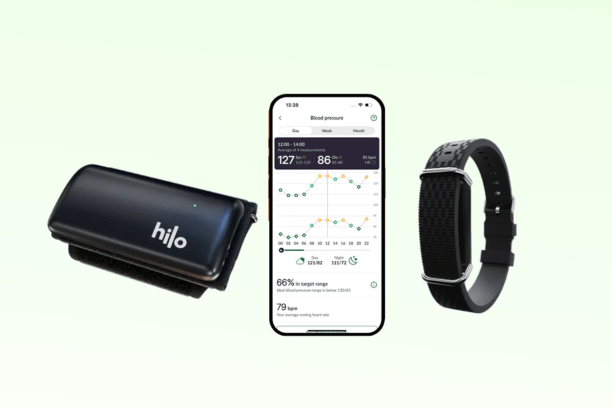
Hilo is a blood pressure monitoring brand designed to help you track changes in your blood pressure throughout the day and night. Its product range works together to provide continuous monitoring, blood pressure measurements, and long-term trend tracking.
The brand states that its system is intended to help you understand blood pressure fluctuations and how factors such as sleep, activity, stress, and daily routines may relate to your readings.
In this review, we will examine the brand’s offerings, product design, key strengths, and potential limitations. We will also evaluate available consumer feedback to assess the brand’s reputation and provide a broader view of what you may experience with the brand.
About Hilo
As per the official website, Hilo was developed from research into cuffless blood pressure measurement that began at the Swiss Center for Electronics and Microtechnology (CSEM) in 2004. The brand focuses on medical technology that uses Optical Blood Pressure Monitoring (OBPM), optical sensors, pulse-wave analysis, and machine learning. It states that its technology has been involved in four major clinical trials and that the Band G1 is CE-marked as a Class IIa medical device under the EU Medical Device Regulation. According to the company, it also reports 35 collective patents associated with its technology.
What Does Hilo Offer?
Hilo offers the Band, Cuff, and App as its core products, along with replacement and alternative straps. Its Band is the wearable component, while the Cuff is used for initial and periodic calibration. The brand also highlights that the App provides weekly and monthly averages, trend data, personalized insights, and doctor-ready reports.
As per the official website, the app also includes features for examining how sleep and activity relate to blood pressure readings, tracking movement alongside cardiovascular data, and viewing time spent within a target blood pressure range. Its accessories include nylon straps in regular and large sizes, as well as medium and large straps available in several color options.
How Does Hilo Work?
Hilo operates through three connected components, which are the Band, Cuff, and App. You subscribe to the service, receive the Band and Cuff, then download the app, create an account, and pair the devices through the in-app setup.
The Band collects physiological signals from the wrist while you are still and at rest, including during sleep. Its optical sensors detect changes in blood flow beneath the skin using photoplethysmography (PPG). As blood moves through the arteries with each heartbeat, blood volume beneath the sensor changes, altering the amount of green light absorbed and reflected by the tissue.
As per the official website, its Optical Blood Pressure Monitoring (OBPM) algorithms use characteristics of those pulse waves to estimate blood pressure patterns. The Cuff provides the reference measurements used to establish a personal baseline and is intended to be used every 30 days again to maintain that reference. The brand also keeps cuff-based measurements separate from the band-derived trend information in its app.
The brand’s approach is designed to capture readings periodically, while the exact number of readings can vary depending on activity and signal quality. This allows the system to build a broader dataset across daytime, nighttime, sleep, steps, and daily routines.
Hilo then organizes this information into averages, trends, and summaries within its app. Looking at these patterns over time can provide more context because blood pressure naturally responds to factors such as physical activity, sleep, and changes in the body’s nervous system activity.
Hilo Advantages
-
Connected Monitoring and Calibration
Hilo integrates the Band, App, and Cuff into a single monitoring system. The brand states that its band is designed for continuous day-and-night monitoring, while the cuff provides the reference measurements used for initial and periodic calibration. It also highlights that the app then organizes the collected readings into trends, averages, and longer-term insights. The brand states that its technology has been validated to the ISO 81060-2 standard, with development supported by four major clinical trials and 35 collective patents. This can give you a more consistent way to track blood-pressure changes over time, with measurement, calibration, data storage, and analysis integrated into a single system.
-
Continuous Cardiovascular Insights
Hilo centers its brand around building a longer-term picture of blood-pressure patterns. Its app brings together weekly and monthly blood-pressure averages, timeline comparisons, Time in Target Range, and blood-pressure stability, while also letting you add medication and health notes to provide context around changes. The brand connects these patterns with sleep duration, daily steps, heart rate, and everyday routines, and its evidence-based insights are designed to help identify relationships between lifestyle factors and cardiovascular trends. The brand also supports doctor-ready reports that summarize blood-pressure data for consultations and allows information to sync with Apple Health or Health Connect. It can help you determine whether a blood pressure change is isolated or recurring over days and weeks, while giving you more context to discuss patterns with your doctor.
-
Quality and Regulatory Expertise
Hilo maintains dedicated quality and regulatory capabilities, including leadership with more than 20 years of experience in regulated industries. This expertise has supported the development and regulatory work for Hilo’s blood-pressure technology, including the FDA 510(k) clearance of the Aktiia G0 Blood Pressure Monitoring System (marketed as the Band) in July 2025, the first over-the-counter cuffless blood pressure monitor in the US. The brand also makes quality documentation available, including an ISO 13485:2016 certificate, declaration of conformity, and CE certification as a Class IIa medical device. Its U.S. offering, Core, leverages this clinically validated technology platform by pairing the continuous optical wristband with an FDA-cleared calibration cuff. This structured approach to quality and regulatory processes can help you assess the brand more transparently when comparing its background and standards with those of other blood-pressure technology brands.
Hilo Limitation
-
Access Continuity Constraints
Hilo ties continuous blood-pressure monitoring to an active membership, making the Band’s long-term functionality dependent on recurring payments. The $239.98 initial package includes the Band, calibration cuff, and 12 months of membership, followed by a 149annualrenewal(12.45 per month). Once the subscription ends, new blood pressure measurements and features stop, even though you keep the Band.
The brand provides 30 days of limited access after cancellation, while historical data remains stored. Continuing to collect new readings and use the related analysis means maintaining the annual membership, so the initial purchase does not represent your complete long-term cost. It creates a long-term cost for continued functionality, limiting the hardware’s utility post-cancellation.
Hilo Alternatives
-
Omron Healthcare
Omron Healthcare and Hilo both focus on blood pressure monitoring, but their approaches differ in scope, device design, and the way blood pressure data is collected. According to its official website, Omron Healthcare offers a broad home-health portfolio that includes blood pressure monitors, scales, nebulizers, and pain-management devices. It also features dedicated accessories for blood pressure, nebulizer, and pain-management products. The brand’s blood pressure category alone includes upper-arm and wrist monitors with different combinations of Bluetooth connectivity, AFib screening, cuff types, storage capacity, and smartphone integration. Hilo takes a more specialized approach, concentrating on a single cardiovascular monitoring system comprising the Band, App, and Cuff. Its system is designed specifically around continuous blood pressure monitoring.
The difference is particularly visible in the range of blood pressure products each brand provides. Omron Healthcare offers numerous upper-arm models, including the Complete Wireless Upper Arm Blood Pressure Monitor + EKG, Platinum, 7 Series, Gold, 5 Series, 3 Series, Silver, Bronze, and Iron. It also offers the Gold Wireless Wrist, 7 Series Wireless Wrist, and 3 Series Wrist monitors. The range gives you different device formats and feature combinations. Hilo has a much more consolidated product structure. Its Hilo Band is the wearable component for continuous monitoring, the App displays and analyzes the readings, and the Cuff is used for initial and periodic calibration. The brand’s model is therefore less about choosing between multiple monitor lines and more about using the three components together.
The brands also take different approaches to obtaining a blood pressure reading. Omron Healthcare’s conventional monitors use cuffs to measure blood pressure, offering both upper-arm and wrist models. Its product selector lets you compare devices based on Bluetooth availability, cuff type, and AFib screening, including upper-arm D-ring and ComFit cuffs. Hilo uses a different measurement pathway. Its Band uses photoplethysmography, or PPG, to collect optical signals from the wrist and applies Pulse Wave Analysis after calibration with the Cuff. The Band detects movement before attempting a measurement and produces a reading only when conditions are suitable, making its measurement process substantially different from that of a conventional cuff reading.
The role of the cuff further distinguishes the two systems. Hilo describes itself as cuffless for everyday monitoring, but its Cuff remains an essential part of the system because the Band must be calibrated initially and approximately once every 30 days. Once calibrated, the Band can continue collecting readings without requiring you to repeatedly apply an upper-arm cuff. Omron Healthcare’s conventional monitors depend on the cuff during each measurement, although you can choose between upper-arm and wrist formats depending on the model. Its blood pressure range, therefore, allows for alternative cuff-wearing positions, while Hilo uses the cuff mainly as a calibration reference for its continuous wearable technology.
Hilo places particular emphasis on connecting blood pressure changes with everyday circumstances. Its App can show how sleep affects readings, link activity and movement with cardiovascular data, and identify patterns associated with meals, stress, medication, and other daily factors. The system is designed to show what happens overnight, during work or activity, throughout the afternoon, and while you sleep. However, Omron Healthcare’s App also provides lifestyle-related insights and helps you understand how your lifestyle impacts heart health, but its underlying data comes from compatible monitors that you use for individual readings.
Omron Healthcare is therefore more oriented toward giving you multiple options for conventional home monitoring and connected spot measurements. Meanwhile, Hilo is built around showing how blood pressure behaves across sleep, movement, stress, meals, medication, and daily patterns.
-
Bio Beat
Bio Beat is centered on medical-grade 24-hour ambulatory blood pressure monitoring (ABPM) to confirm hypertension and support clinical management. In comparison. Hilo is a continuous, long-term monitoring system that tracks blood pressure throughout everyday life.
As per its official website, Bio Beat uses a wireless, non-invasive chest patch to collect measurements during a defined 24-hour period. Hilo combines a wrist-worn Band, App, and Cuff to provide ongoing monitoring without requiring repeated manual measurements. This makes Bio Beat more aligned with a structured clinical ABPM workflow, while Hilo emphasizes continuous visibility into blood pressure patterns across days, weeks, and months.
The physical design of each system reflects this difference in use. Bio Beat’s core device is a medical-grade chest patch that remains attached for the 24-hour monitoring period and is then removed, allowing the monitoring process to fit into a defined diagnostic episode. It can work after an office diagnosis or suspicion of hypertension. This is followed by placement of the chest patch, connection to a mobile app, 24-hour monitoring, automatic report generation, and patch removal. Hilo is designed for substantially longer-term wear through its Band, which is intended to remain on the wrist throughout the day and night, including during sleep. The Band is rated IP68, allowing it to be worn while showering, swimming, washing dishes, or when splashing, although the brand specifies that it should not be used for diving or snorkeling.
The technologies used to obtain those cuffless measurements differ in their implementation. Bio Beat describes its option as using a proprietary, patented PPG sensor within its chest-patch system. The company states that its technology is intended to provide physicians with precise insights into blood pressure patterns and support more informed decisions. Hilo states that its device uses optical PPG sensors at the wrist and applies pulse wave analysis to the resulting signals. Its Band shines a green light into the skin to detect changes in blood flow and analyzes the shape of individual pulse waves.
Nighttime monitoring is important to both brands, though each approaches it differently. Bio Beat considers nighttime measurement as an essential component of 24-hour ABPM, helping clinicians see blood pressure patterns that can be missed during an office visit and supporting the identification of white-coat and masked hypertension. The company specifically highlights the ability to obtain nighttime readings while allowing uninterrupted sleep. Hilo combines nighttime monitoring into its always-on wearable model, continuing to collect measurements while the wearer sleeps and showing how overnight blood pressure behaves alongside daytime patterns. Its platform specifically allows blood pressure trends to be viewed in relation to sleep, stress, movement, meals, and medication.
Bio Beat is specifically structured as a 24-hour clinical monitoring and diagnostic option, whereas Hilo extends cuffless monitoring into a continuous, longitudinal system that shows how blood pressure changes across everyday activities.
Pros
- Combines engineering, clinical, and research expertise.
- Supported by European deep-tech investors.
- FDA-cleared and CE-certified technology platform.
Cons
- Services require an ongoing annual subscription.
- Customer support experiences vary between users.
How Did We Evaluate?
-
Brand Credibility
Hilo is a relatively new consumer-facing brand, but its underlying technology has a much longer development history. The technology originated from research at Switzerland’s CSEM beginning in 2004, and Aktiia was founded in 2018. The company states that its technology is supported by more than 20 years of research, 35+ patents, four major clinical trials, and more than 120 peer-reviewed publications.
We also considered the brand’s presence on consumer review platforms. It is currently not listed with the Better Business Bureau, so there is no BBB rating or complaint history available to provide additional insight into its business reputation. On Trustpilot, the brand has a 3.7-star rating based on 5,000+ reviews, indicating a mixed customer experience. Some customers praise the support team for quickly resolving problems, replacing faulty bands, or providing additional accessories. However, others report slow responses, repeated interactions with automated chatbots, and problems getting assistance with damaged or unavailable replacement components.
Another struggled to obtain a replacement bracelet under warranty because the replacement was out of stock. In comparison, a customer who initially could not calibrate the device eventually received a full refund after a human representative became involved. This suggests that support can be effective once a case reaches a human representative, but the assistance may not always be smooth.
Our evaluation suggests that the brand has a credible technical and research background, but its customer experience is less consistent than its underlying history might imply. Its roots support its legitimacy as a health-technology brand. The brand can be viewed as an established technology with a relatively young consumer brand presence and a mixed real-world reputation, making its technical background reassuring.
-
Real User Experiences
We evaluated Hilo by examining Reddit experiences focused specifically on its device’s blood pressure monitoring performance, ease of use, calibration process, comfort, consistency, and long-term usefulness.
The feedback is mixed, with several users appreciating its ability to provide frequent blood pressure readings without repeatedly using a conventional cuff. Users described the wearable format as convenient for monitoring blood pressure throughout the day and during sleep, with some saying it helped them recognize changes associated with medications, diet, and other daily habits. One user also reported that the brand helped identify nocturnal hypertension, while another said that regularly viewing readings helped them make lifestyle adjustments and track improvements over time.
Hilo’s ability to show longer-term blood pressure trends was one of the most consistently praised aspects. Several users said they found the device useful for identifying upward or downward patterns. Another user said that taking numerous readings throughout the day provided a clearer picture of their blood pressure than occasional measurements.
Ease of use was another positive point. Users described the brand’s band as something they could wear continuously, including overnight, with minimal disruption. However, the original Hilo strap received several complaints. Users reported skin irritation, discomfort, and rashes after wearing it for extended periods, with some recommending or using alternative straps.
Accuracy and consistency were the biggest areas of concern in the Reddit feedback. Multiple Hilo users reported substantial differences between readings from the band, the calibration cuff, and other blood pressure monitors they already trusted. Some users described readings that were consistently 10–20 mmHg different from those on their other devices, while others reported even larger discrepancies.
The calibration process also generated concerns. Several users felt that its band was highly dependent on the cuff measurement used during calibration, meaning an inaccurate or unrepresentative calibration reading could potentially influence subsequent band readings. Some users reported that changing their calibration technique resulted in readings that became closer to their other monitors, while others remained dissatisfied despite repeated calibration and troubleshooting.
The Reddit feedback suggests that Hilo offers a convenient way to monitor blood pressure trends over extended periods. Meanwhile, its offerings’ inconsistent readings, calibration issues, strap irritation, limited alerts, and subscription costs pose meaningful drawbacks.
Conclusion
Hilo focuses on continuous monitoring, data-driven insights, and long-term blood pressure patterns. The brand claims to give you a broader understanding of how blood pressure changes throughout everyday life.
However, its approach comes with practical trade-offs. The ongoing membership increases long-term costs, while customer feedback highlights inconsistent support and concerns about measurement discrepancies, calibration, comfort, syncing, and limited alerts. These issues can affect how consistently you use and rely on the brand over time.
Before relying on the brand’s data, keep your measurement conditions consistent and pay attention to unusual changes instead of interpreting isolated results on their own. You should also avoid allowing the convenience of continuous monitoring to replace established blood pressure monitoring practices when a reading appears concerning. Hilo is best viewed as a specialized brand for building a broader picture of blood pressure behavior, with its value depending on how carefully you interpret and use the information it provides.

Rachel has been a freelance medical writer for more than 18 years. She graduated from the University of Tennessee at Knoxville in 2005 and is currently practicing as a Certified Registered Nurse Anesthetist at a Level I trauma center.
Leave a Reply