

No products in the cart.
Contents
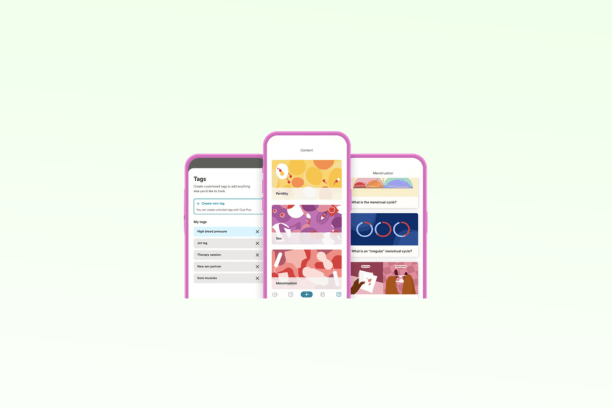
Clue focuses on helping you track, understand, and anticipate different phases of your cycle through data-driven insights. It centers its offerings around digital tools that allow you to log details such as period flow, ovulation, mood, sleep, energy levels, and physical symptoms.
The brand’s approach is built around helping you make more informed decisions while contributing anonymized data to ongoing studies in the femtech space.
In this review, we will explore what the brand offers in detail and how it compares with similar cycle-tracking brands. We will also evaluate how real users respond to its offering through an evaluation of real user reviews.
About Clue
Clue is a digital health brand operating in the femtech space, built around menstrual and reproductive health tracking. The brand’s core offering revolves around its cycle-tracking platform, which helps generate predictions and identify recurring patterns.
As per the official website, the brand offers features in multiple tracking categories designed to reflect different life stages and needs. This includes menstrual cycle tracking, fertility-focused support through Clue Conceive, pregnancy tracking with week-by-week updates, and perimenopause tracking.
The brand follows a tiered model. The free version covers basic tracking and cycle predictions, while its premium subscription, Clue Plus, expands into advanced analytics, deeper cycle insights, custom tracking tags, and features like cycle sharing through Clue Connect.
Key Offering
-
Clue App
Clue app can help you monitor your cycle, predict ovulation and menstruation, and understand patterns in your body. The app allows you to log cycle-related data such as bleeding, symptoms, mood, sleep, and other health indicators.
The core functionality centers on cycle tracking and prediction. You can record over 30 types of health data, including physical symptoms and lifestyle factors, which may help you identify trends across cycles. The app uses this data to estimate your next period, fertile window, and premenstrual phase. Such predictions are based on historical cycle patterns and statistical modeling, which may provide useful guidance but do not guarantee exact timing. The app also includes reminders and calendar views, which support planning around your cycle.
Clue offers different modes, including standard tracking, fertility tracking through Clue Conceive, pregnancy tracking, perimenopause tracking, and tracking without a period. These modes adjust the algorithm and content to reflect different life stages or goals.
Pros
- Covers multiple reproductive life stages within one brand ecosystem.
- Operates under General Data Protection Regulation (GDPR ) standards.
- Brand’s application tracks 100+ health and lifestyle factors.
Cons
- The subscription model creates an ongoing cost.
- Users report uninformed policy or pricing changes.
Advantages
-
European Data Governance Framework
Clue states that its users’ health data is protected by German and European privacy law. It applies GDPR protections and includes granular privacy settings that can be changed inside its app. The brand also maintains dedicated legal layers, such as Consumer Health Data disclosures and U.S. supplemental privacy notices. It integrates user-level privacy controls through configurable consent and processing settings, allowing you to manage certain tracking and data-sharing preferences directly within the ecosystem.
You may find this especially relevant if you want cycle tracking without storing intimate reproductive data under a U.S.-based health app framework. The brand builds its privacy controls and legal positioning into its operating model, which matters if you are tracking sensitive reproductive-health information.
-
Lifecycle Tracking Architecture
Clue organizes the app into distinct modes for Period Tracking, Conceive, Pregnancy, Perimenopause, and Clue Tracking. The brand separates basic cycle predictions from mode-specific guidance, expert content, and condition-relevant tracking. It has also added perimenopause support, no-period tracking, health-condition features, and wearable integrations. You may find it easier to stay with it over time if your reproductive stage changes. It reduces the need to change platforms when your goals shift from routine tracking to conception, pregnancy, perimenopause, or non-bleeding symptom monitoring.
Potential Limitations
-
Restricted Contraception Utility
Clue operates with a narrow contraceptive utility framework, as its app’s current system functions primarily as a cycle-tracking and logging tool. Although it previously received FDA clearance for Clue Birth Control, the feature has remained limited in availability during its app’s redesign phase. If you want regulated contraceptive guidance or biomarker-confirmed fertility tracking, you may need to use a second platform alongside Clue. It also carries higher practical stakes because the platform’s cycle predictions can resemble fertility guidance despite the app’s disclaimers against contraceptive reliance. You may need to distinguish carefully between general cycle predictions and a clinically deployed contraceptive system. As the app’s system relies primarily on calendar-based cycle modeling, prediction reliability may become less dependable when cycle regularity changes or ovulation timing fluctuates.
-
Algorithm Input Constraints
Clue positions the Clue app as a science-backed cycle tracking platform, but its current predictive structure remains primarily calendar-based, even when wearable integrations are connected.
According to the brand’s published guidance, biometric inputs imported into the app do not currently function as active inputs within its core cycle prediction, fertile-window estimation, or ovulation forecasting systems. Physiological signals collected through connected wearables may appear alongside cycle records without dynamically changing prediction outcomes in real time. The brand’s current forecasting framework prioritizes historical cycle analysis over continuous physiological recalibration. This may present a potential concern if you expect wearable biometrics within the Clue app to actively influence real-time cycle predictions, fertile-window calculations, or ovulation forecasting.
Alternatives To Clue
-
Tempdrop
Tempdrop and Clue both offer app-based tracking, but they build their ecosystems differently. According to its official website, Tempdrop pairs its app with a wearable sensor that you place on your upper arm before sleep. This allows it to continuously record temperature data overnight and sync it later at your convenience. Clue, however, offers a standalone app experience, where you actively log cycle data, symptoms, and experiences, and receive insights without relying on any external device.
The purpose behind each brand’s app highlights a clear contrast. Tempdrop claims that its app is structured around fertility awareness methods. It aims to help you increase your chances of conceiving or track ovulation by identifying temperature shifts after ovulation and combining them with symptom tracking. The brand’s system walks you through steps such as wearing the sensor at night, syncing data, logging symptoms, and interpreting results, with optional premium features for automatic interpretation. Clue expands its scope significantly through the app, covering period tracking, trying to conceive, pregnancy, perimenopause, and scenarios where you track hormonal patterns without menstrual bleeding.
Their data collection models are fundamentally different. Tempdrop states that its offering uses multiple sensors and a patented active temperature-noise cancellation algorithm to continuously monitor your core temperature during sleep. This makes it suitable even if your schedule changes frequently. However, Clue’s app depends entirely on self-reported data, allowing you to track symptoms in seconds, log mood changes, and build a dataset over time that helps predict PMS, ovulation, and upcoming periods based on patterns it identifies.
In terms of features, Tempdrop’s app combines temperature tracking with fertility insights, offering ovulation confirmation and personalized cycle interpretation. Its premium version also includes a calendar view that forecasts cycles up to six months ahead and access to Tempdrop Academy, which explains menstrual cycle phases and fertility awareness methods. Meanwhile, Clue’s offering is structured differently, with a free version that provides essential cycle statistics and basic predictions. In comparison, its Clue Plus unlocks unlimited tracking customization and features like Clue Connect for sharing your cycle with a partner, along with access to expert-led educational content.
Tempdrop combines a wearable sensor with an app to provide continuous, temperature-based fertility tracking with minimal manual input. Meanwhile, Clue supports a wider range of cycle-related needs through manual tracking and research-driven insights.
-
Natural Cycles
Natural Cycles structures its offering into five distinct modes, such as NC° Birth Control, Plan Pregnancy, Follow Pregnancy, Postpartum, and Perimenopause. It emphasizes that you can move between these modes as your goals evolve, from preventing pregnancy naturally to monitoring recovery after childbirth or understanding hormonal shifts during perimenopause. Clue, in comparison, features a women-led period and cycle tracker app, built to support everyone with a cycle from the first period to perimenopause. Its structure revolves around categories like Period Tracking, Trying to Conceive, Pregnancy, Perimenopause, and No Period tracking, along with an encyclopedia and expert-led content.
The way each brand’s app functions further separates their approach. Natural Cycles states that its app follows a three-step daily process that includes measuring temperature overnight using the NC° Band or compatible wearables. You just need to open the app to sync and analyze data, and confirm your fertility status for that day. Its algorithm uses physiological signals such as the temperature rise after ovulation to determine whether you are in your fertile window, which it defines as roughly six days per cycle. This allows the app to give clear, action-based outputs, such as when to use protection or when to try to conceive. However, Clue mentions that its app focuses on quick, user-reported inputs, letting you log symptoms, mood changes, bleeding, and other cycle-related experiences in seconds. It translates this data into predictions about your next period, PMS, ovulation timing, and symptom patterns, helping you anticipate changes.
The contrast becomes sharper when you look at scientific validation and positioning. Natural Cycles claims that its app is the only FDA-cleared birth control app, supported by 27 published studies. Meanwhile, Clue’s scientific credibility is built differently, focusing on collaborations with institutions such as Oxford University, MIT, Berkeley, and the Kinsey Institute, and using real-world data to contribute to studies on menstrual health and global reproductive patterns. As per their official website, Natural Cycles leans toward a structured, outcome-driven experience built around fertility decisions and clinical validation. Meanwhile, Clue offers a widely accessible, education-rich tracking platform designed for long-term engagement and deeper cycle awareness.
How Did We Evaluate?
-
Brand Credibility
To evaluate Clue’s brand reputation, we reviewed its presence on third-party platforms such as the Better Business Bureau and Trustpilot. We found that the brand is not listed on these platforms, which limits access to verified details like complaint history and how disputes are handled.
Since there are no consistent third-party details available, it becomes difficult to independently assess the brand’s reputation in areas such as app performance and customer support. This also makes it harder to fully evaluate the platform’s credibility and trust level based on independent sources.
-
Real User Experiences
We assessed the real user experiences for Clue by reviewing publicly available discussions about the brand on Reddit. Across the user discussions, some describe frequent pop-ups that interrupt basic actions like logging cycle data, with repeated prompts appearing during routine use. These interruptions are often described as frustrating for users who rely on the app primarily for simple tracking.
However, other users report a more stable experience after switching to the paid version. They note that the premium subscription provides consistent tracking, additional features, and access to educational content, which makes the app more usable over time. Some also mention long-term use without major issues, suggesting reliability for those who choose to upgrade.
The feedback reflects a contrast between the free and paid experiences. While the app is seen as reliable and feature-rich in its paid form, there are recurring concerns around interruptions and feature limitations in the free version.
Based on the discussion, the experience may involve a trade-off between accessibility and consistency, so long-term satisfaction will likely depend on your expectations and how you plan to use the app.
Frequently Asked Questions
- Can Clue predict PMS symptoms accurately?
The brand can indicate PMS patterns through its app, but its accuracy depends on how consistently you log data. After around three complete cycles, the app builds a baseline, and PMS predictions appear only when you’ve explicitly tracked PMS symptoms, improving gradually over time. - Does Clue account for lifestyle factors like stress or travel?
The brand features an app that allows you to log lifestyle factors like stress, sleep, and environmental changes, such as travel. While there’s no dedicated travel option, these inputs appear in the Analysis tab to help you observe how they may influence cycle patterns. - Can Clue help track medication effects on your cycle?
The brand offers support by allowing you to log medications in its app using features like custom tags and reminders, including specific modes for hormonal therapy. You can observe patterns by tracking symptoms alongside intake, though the app does not directly interpret medication effects.
Final Words
Clue focuses on structured cycle tracking built on statistical modeling and longitudinal data patterns, drawing from research areas such as reproductive epidemiology and chronobiology. The brand outlines its offering through a tiered structure, which limits the depth of interpretation available without a subscription. Pregnancy-related features are also present but remain relatively basic unless accessed through the premium tier, which may reduce comparability with brands offering more extensive support in this area.
Clue’s operational scope is also confined to its digital ecosystem across iOS, Android, and web platforms, with no offline functionality for new users. Access, therefore, depends on device compatibility and consistent internet availability. The brand states that its app’s reliance on historical data means prediction accuracy can vary, particularly in cases of irregular cycles or external influences such as stress.
When seeking support from Clue, it is important to consider some precautions. Its app does not support contraception or conception planning, and its outputs should not be interpreted as clinical guidance. Data correlations within the platform remain observational and do not establish causation. The variability in cycle patterns can also affect the consistency of predictions over time.

Rachel has been a freelance medical writer for more than 18 years. She graduated from the University of Tennessee at Knoxville in 2005 and is currently practicing as a Certified Registered Nurse Anesthetist at a Level I trauma center.
Leave a Reply