

No products in the cart.
Contents
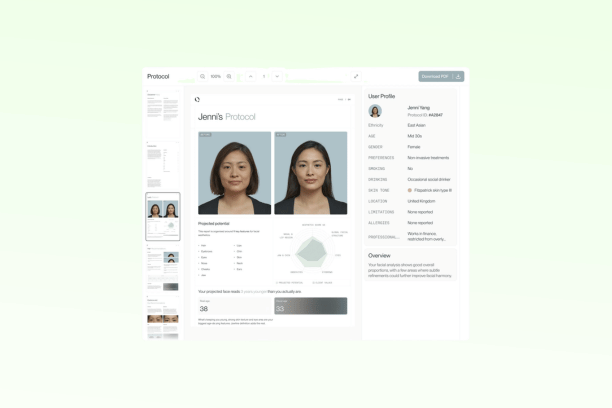
Qoves offers detailed facial analysis and personalized advice on appearance. It looks at features such as facial proportions, symmetry, skin, eyes, and jawline to give you a better understanding of your facial structure.
The service goes beyond a basic facial assessment by providing recommendations based on your individual features. However, how useful are these recommendations in practice, and is the service worth the price?
In this review, we’ll take a closer look at what it offers, how its analysis works, what customers think of it, and where the service may fall short.
About Qoves
Qoves was founded by Shafee Hassan, who began exploring how computer vision could help explain what makes faces appear attractive. It has since developed into a service that analyses facial features and offers personalized advice on appearance.
The service operates on an annual membership model, which the company offers at $150 per year. It includes one facial analysis annually, a personalized improvement plan, biometric scores and progress tracking, and access to the team through a dashboard chat.
Personalized Facial Analysis
Qoves examines more than 160 facial features and characteristics, covering areas such as the eyebrows, eyes, nose, lips, cheeks, skin, and jawline. Its assessments look at details including eyebrow density, eye curvature, lip smoothness, facial proportions, and symmetry. The features are assessed separately, giving you a detailed breakdown of your facial characteristics instead of a single overall attractiveness score.
The analysis starts with six facial photographs taken from different angles and uploaded through the online portal. Facial landmarking technology is used to map the face and takes factors such as age, ethnicity, location, lifestyle, and personal preferences into account when preparing its recommendations.
The brand also states that its reports undergo human review. Results include biometric scores and comparisons with demographic reference data, helping explain how your individual features relate to its assessment criteria.
The report then outlines potential areas for improvement and provides recommendations tailored to your features. Depending on the assessment, you may also see visual previews of possible changes, along with suggested approaches and expected timelines.
The brand offers progress tracking to help you review changes across assessments over time. These scores and visualizations provide a reference for exploring different options, but they cannot guarantee a particular result or predict exactly how a change will affect your appearance.
Qoves Advantages
-
Detailed Facial Feature Analysis
Qoves analyzes more than 160 facial and aesthetic markers, including skin quality, facial symmetry, eye shape, and eyebrow density. Its facial landmarking protocol maps 521points on your face to assess chin projection, ear protrusion, nose symmetry, and smile lines.
This detailed breakdown helps you understand which facial features contribute to your appearance instead of relying on a general attractiveness assessment. You can use these insights to identify areas you may want to focus on, whether that means refining your grooming routine, exploring different hairstyles, or considering non-surgical aesthetic improvements.
-
Personal Preference Integration
Qoves uses information collected during onboarding, including demographic details, lifestyle factors, and comfort levels regarding aesthetic changes, to tailor its recommendations to your assessment. Depending on your report, these may cover hairstyles, eyebrow grooming, skincare routines, or non-surgical aesthetic procedures, helping narrow the options to areas relevant to your preferences.
The platform also maps facial landmarks to generate portrait-specific visual simulations of potential structural adjustments. These side-by-side references give you a way to compare possible changes in relation to your own facial proportions before deciding which options to explore. You receive recommendations informed by your assessment and personal preferences, along with visual simulations that help you compare potential changes before deciding what to explore further.
Qoves Limitation
-
Membership Flexibility Constraints
Qoves charges $150 for an annual membership, which can be expensive if you only want a single facial assessment. Although you can cancel to avoid future renewals, the initial payment covers a full year instead of one time analysis. If you have little reason to return after receiving your report, much of that paid access may go unused.
The annual model can also be limiting when you want to reassess your facial metrics or track changes during the year. If additional assessments require separately purchased report add-ons, monitoring your progress can involve extra costs beyond the membership fee. You pay for a full year of access even if you only need one assessment, and repeat analyses may cost extra, making it expensive for occasional use or infrequent progress tracking.
Qoves Alternatives
-
ClinicEvo
ClinicEvo combines facial analysis with an EvoPlan™ covering skincare, grooming, hairstyles, makeup, colour matching, and progress tracking. You can use it to explore everyday changes, from refining your brows to improving skin clarity. Qoves focuses more on understanding facial aesthetics and deciding which changes to prioritize. Its improvement protocol draws on more than 450 methods, with recommendations intended to guide non-surgical appearance changes.
ClinicEvo states that it uses more than 65 proprietary AI models and a 468-point facial landmark system. It also describes reconstructing a 3D vector of your face from six angles, with facial proportion and symmetry measurements claimed to be accurate to approximately 2 mm. Qoves uses a 521-point facial landmark system and more than 160 aesthetic assessments covering proportion, dimorphism, averageness, neoteny, contrast, and symmetry. Its reports can compare eye curvature with demographic averages or assess forehead wrinkle depth against age-related and demographic expectations.
As per its official website, ClinicEvo examines the hair, eyebrows, eyes, nose, cheeks, jaw, lips, chin, skin, neck, and ears. It combines individual scores with an assessment of facial harmony, then connects findings such as brow density, lip smoothness, facial thirds, and skin clarity to practical recommendations.
Qoves breaks facial characteristics into more specific assessments. It includes 26 eye assessments, 17 nose assessments, 13 cheek assessments, and 11 jaw assessments, alongside evaluations of other facial areas. An eye assessment might examine tilt, curvature, eyelid exposure, shape, and under-eye health, while a nose assessment considers shape and its contribution to perceived facial femininity or masculinity.
Your preferences play a direct role in ClinicEvo’s EvoPlan™. The brand says it considers facial structure, heritage, age, location, lifestyle, budget, and aesthetic goals, alongside habits such as sleep, diet, and stress. You can also indicate whether you prefer subtle refinements or more noticeable styling changes. Qoves considers many of the same personal factors, including age, ethnicity, lifestyle, budget, location, and cultural beauty standards. Its approach relies on comparing your measurements with relevant demographic references and accounting for natural changes in skin, bone structure, and fat distribution as you age. For example, it may assess eye curvature against averages for your age and demographic group.
ClinicEvo extends its analysis into personal colour matching and routine skincare. Its colour-season tool identifies one of 12 seasons based on undertone, value, and chroma, using concepts associated with the Munsell colour system. The resulting palette helps you understand whether warmer or cooler, lighter or deeper, and clearer or more muted shades may complement your natural colouring. Its paid membership also includes daily evoScore™ checks, skin scans for wrinkles, texture, pores, and clarity, plus weekly dermatology insights and skin tracking. Qoves focuses more on monitoring facial measurements over time. Its tools let you review progress, compare changes with or without following recommendations, and repeat assessments to build a longer-term record. It also offers a letter containing protocol details, progress observations, and scientific context.
As per their official website, ClinicEvo is more oriented toward ongoing styling and skincare routines. Meanwhile, Qoves tracks changes against its facial improvement protocol.
-
Facet
Facet gives you a facial analysis in about 60 seconds, with individual scores, research citations, and a prioritized improvement roadmap. Qoves takes a more personalized approach, combining facial measurements with demographic comparisons, personalized protocols, visual previews, and human-reviewed analysis.
As per its official website, Facet maps 468 facial landmarks and runs 161 tests across 12 specialist modules. These cover your eyebrows, eyes, nose, lips, cheeks, jawline, skin, hair, beard, body composition, and posture. Its assessments include 26 eye tests, 22 skin tests, and 17 nose tests. Qoves maps 521 facial points and evaluates more than 160 aesthetic markers, including symmetry, proportion, neoteny, contrast, and dimorphism. It also examines your chin, smile, neck, and ears.
Getting your analysis started is simpler with Facet. You upload one clear, front-facing photo in JPEG, PNG, or HEIC format. The company states that it encrypts the image immediately before its AI evaluates your facial symmetry, proportions, skin, and structural geometry. Qoves requires six photographs, including front-facing, side-profile, and quarter-profile views. These additional angles assess details such as ear protrusion, chin projection, eyebrow density, nose symmetry, and smile lines.
Facet’s improvement roadmap helps you decide where to start by ranking suggested changes across skincare, grooming, and medical aesthetics. Impact scores help prioritize areas for attention, with recommendations tied to observations such as redness or visible pores. Qoves goes further into implementation through a transformation protocol drawing on more than 450 evidence-based improvement methods. Recommendations can include cost, difficulty, frequency, and expected timeframe.
Repeated assessments serve different purposes across the two platforms. Facet includes unlimited rescans, allowing you to upload new photos and compare individual metrics as your skincare or grooming routine changes. Qoves combines biometric tracking with visual previews of possible adjustments. This includes darker eyebrows, different levels of facial femininity or masculinity, and potential non-surgical changes. Its tracking features include symmetry, averageness, proportionality, homogeneity, and visual age, with sample comparisons. Lifetime tracking lets you compare assessments over time, while visualizations help you explore possible changes before deciding what to pursue.
Pros
- Analyzes 160+ facial beauty markers.
- Provides personalized facial improvement protocols.
- Considers ethnicity and demographic-specific facial characteristics.
- Includes biometric scores and progress tracking.
Cons
- Users reported that the platform’s hairstyle suggestions lack variety.
- Customers also highlighted delayed support responses.
How Did We Evaluate?
-
Brand Reputation
Founded in 2019, Qoves has developed a specialized approach to facial analysis, combining computer vision, research-informed recommendations, and human review. However, its background and stated methodology do not independently establish how accurately its reports identify individual features or predict the results of recommended changes.
On Reddit, users have reported mixed experiences. Some customers reported receiving their results in approximately four days. However, the report failed to identify a crooked nose they considered noticeable. Other users described the service as inaccurate or unconvincing, although these personal experiences do not establish how frequently such problems occur.
Some customers questioned whether spending an extra $150 on surgical recommendations was worthwhile, especially after noticing inaccuracies in their initial report.
Based on our observation, we believe that this service may provide some understanding for grooming and non-surgical improvements, but the value you receive depends on the accuracy and relevance of your individual report. The presence of research-informed methods is a positive aspect of its offering, yet the experiences indicate that some customers receive recommendations or scores they find difficult to reconcile with their actual features. We would suggest approaching the brand cautiously, evaluating the initial report on its own merits, and avoiding spending extra on surgical recommendations without independent professional guidance.
-
Real User Experiences
We evaluated Qoves by examining customer feedback on Trustpilot, where the brand holds a 4.6 out of 5 rating from more than 800 reviews.
Customers frequently described their analyses as detailed, well-structured, and easy to understand, with explanations of facial features and suggestions for improving their appearance. Some users appreciated the focus on small, achievable adjustments involving skincare, grooming, and styling instead of drastic changes. Others found the reports helpful for understanding which aesthetic procedures might align with their goals.
However, the experience was not consistent across all customers. Several customers felt that the recommendations were too generic, repeated advice they already knew, or overlooked details such as their hair texture, density, and existing styling preferences.
We also considered the accuracy and usefulness of visual transformations and hairstyle suggestions. While some customers were pleased with their proposed transformations and found the recommendations realistic, others criticized the generated images for looking artificial or failing to reflect the changes explained in their reports.
Many also praised the team for responding promptly, explaining recommendations in detail, and helping with follow-up questions about skincare ingredients, eyewear, and alternative styling options. However, there were some isolated complaints about delayed priority analyses and difficulty accessing purchased services.
Based on our assessment, the brand gives you a structured approach to facial aesthetics. However, the mixed feedback means the quality of the experience is not guaranteed to be consistent. The platform is best viewed as a starting point for informed aesthetic decisions, with its recommendations evaluated against your preferences and, where medical procedures are involved, independent professional advice.
Conclusion
Qoves gives you a more analytical way to explore facial aesthetics, using facial measurements and research-informed principles. However, your results also depend on the quality of your photos and the accuracy of the assessment, so differences in lighting, camera angle, or facial positioning may affect the measurements.
The brand follows an annual membership, which may be difficult to justify if you only want a single evaluation, especially when the recommendations do not guarantee visible improvements.
You should also distinguish aesthetic observations from medical findings. A report cannot establish the cause of hair loss or skin changes, and a visual preview cannot reliably predict the outcome of a cosmetic procedure. It is essential to use this service to explore options and formulate questions, not as the sole basis for spending money on procedures or making changes that carry medical risks.

Rachel has been a freelance medical writer for more than 18 years. She graduated from the University of Tennessee at Knoxville in 2005 and is currently practicing as a Certified Registered Nurse Anesthetist at a Level I trauma center.
Leave a Reply