

No products in the cart.
Contents
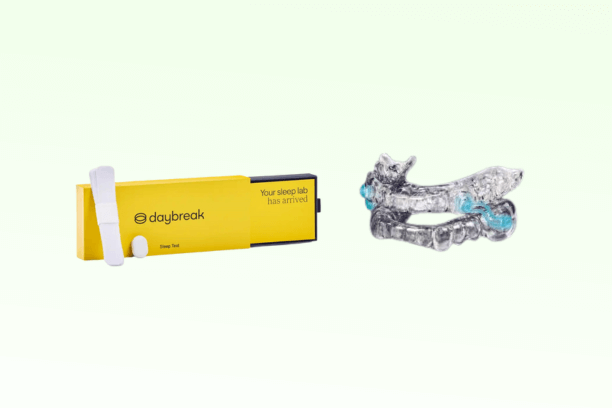 Daybreak focuses on supporting and improving sleep quality by targeting concerns related to obstructive sleep apnea and snoring. The brand does so by providing access to an at-home sleep test kit and a custom-fit oral device, after review by licensed sleep specialists and dentists.
The custom-fit oral device may help move the lower jaw slightly forward to help reduce snoring and associated sleep-related concerns. For added convenience, the brand also offers insurance reimbursement and a warranty on the device.
This review discusses the brand in detail, covering its background and focus, the legitimacy of its online assessments, and the features of its custom-fit oral device. In the review, we also explore the associated advantages and potential limitations.
About Daybreak
Daybreak positions itself as a doctor and sleep-specialist developed brand, offering an at-home approach to help screen for and receive support for obstructive sleep apnea.
The brand offers a streamlined process that begins with its wireless FDA-cleared At-Home Sleep Test, which records your nighttime breathing patterns. A licensed doctor then reviews such recorded data for an official diagnosis of sleep apnea.
Once analyzed, you complete an impression kit so a dentist can oversee the creation of your custom mandibular advancement device, without the need for in-person clinic visits. The device is made to help keep your airway open during sleep, which may help reduce snoring and minimize some discomfort associated with sleep apnea.
According to its official website, Dr. Martin Hopp, PhD, M.D., is the medical director for the brand, who has multiple years of experience as a sleep specialist. Dr. Balacky, a specialist in maxillomandibular advancement, helps guide the development of the brand’s custom-fit oral mouthpiece.
The manufacturer claims that the brand’s oral devices are FDA-cleared and fabricated in an accredited U.S. dental laboratory. Daybreak also highlights its focus on quality and craftsmanship by offering a 3-year replacement commitment for any mandibular advancement device that fails due to defects in materials or workmanship.
Daybreak Offerings
-
At-Home Sleep Test
The At-Home Sleep Test is a two-night test setup that could help measure variances in your sleep patterns, which may help licensed doctors in diagnosing concerns like sleep apnea. According to the official site, it offers a kit that includes a small wireless monitor that fits on your finger and records essential sleep-related vital signs while you rest. The wireless monitor further integrates with a mobile app, which receives and stores your overnight readings.
As per the official website, the At-Home Sleep Test is FDA-cleared and offers around 98% accuracy in detecting sleep apnea. The wireless monitor in the kit typically measures relevant data critical in the evaluation of sleep apnea, such as blood oxygen levels, heart rate patterns, and movement-related sleep interruptions. All collected information is analyzed by licensed doctors, who interpret the data and provide the formal diagnostic outcome.
-
Daybreak Device
Post-completion of the diagnosis, the brand provides you with impression materials and an instructional guide to create a mold of your teeth. After you send the custom mold impressions of your teeth to the brand, it usually takes them around 2–3 weeks to prepare your custom-fit Daybreak Device.
The manufacturer suggests wearing the custom-fit oral device while you sleep. It works on the principles of mandibular advancement, where it holds your lower jaw slightly forward and increases tension in the genioglossus muscle, which helps maintain your tongue’s position. Such effects may prevent the tongue from falling back toward your throat during sleep. This forward jaw positioning could limit the collapse of soft tissues that may otherwise interfere with breathing.
According to its official website, the Daybreak Device is FDA-cleared to manage obstructive sleep apnea and reduce snoring. The brand positions the device as a portable and convenient option compared to continuous positive airway pressure (CPAP) machines.
Advantages Of Daybreak
-
Medically Supervised Sleep Support
Daybreak states that its process is guided by licensed physicians and dentists who oversee each step from reviewing the results of the at-home sleep test to providing custom-fit mouthpieces. As per its official site, Dr. Martin Hopp (PhD, M.D.) is the brand’s Medical Director, who is a Cedars-Sinai obstructive sleep apnea specialist. Dental oversight is attributed to Dr. Peter Balacky, D.D.S., who is a board-certified oral and maxillofacial surgeon with a specialization in jaw advancement and airway improvement.
As per the brand’s claims, these clinicians review two nights’ worth of sleep data gathered through the finger-worn sensor and app. They confirm the sleep-study findings and diagnosis of sleep apnea, determine whether you qualify for an oral appliance, supervise impressions and bite alignment, check device fit, and review updates you submit through the app.
Such a medically-supervised setup may imply that your sleep-test information, impressions, bite records, and ongoing reports are reviewed by clinicians rather than being handled only by automated systems. It may also give you clearer guidance during each step since clinicians review your progress directly.
-
Coverage-Compatible Approach
Daybreak claims that its at-home sleep test and custom-fit oral mandibular advancement device can be paid for using FSA or HSA funds. As per its official site, the brand also highlights that many major health insurance providers, including Aetna, Cigna, United Healthcare, and EmblemHealth, recognize its offerings and offer coverage.
You may use the online Insurance Check provided on the brand’s official website to share your insurance details, which may help the brand review potential coverage, estimate deductible and coinsurance responsibilities, and provide an expected out-of-pocket amount before you proceed. The official site also highlights that medical insurance, not dental insurance, typically covers physician-prescribed oral appliances.
The brand also states that coverage requirements may vary by obstructive sleep apnea severity. Mild cases may require a related comorbidity, moderate cases tend to receive approval more consistently, and severe cases may need documentation of prior CPAP use. Such a direct compatibility with insurance and FSA/HSA coverage could make access to the brand’s offerings more manageable and help reduce direct costs.
Potential Limitation
-
Limited Long-Term Clinical Evidence
The brand does not offer peer-reviewed or independently published research that evaluates its Daybreak Device or the accuracy of its At-Home Sleep Test. The brand shares internal metrics, including its own effectiveness percentages, accuracy data from the at-home sleep test, and user-reported improvements, but none of these are supported by external clinical studies.
While the brand refers to general research on mandibular advancement devices, it does not provide long-term data specific to its devices, the custom digital impression process, or outcomes observed across several months in its remote-use pathway. There are also no independent publications assessing the durability of the device or changes in sleep apnea severity over time.
You also won’t find published data confirming long-term adherence, wear-and-tear patterns, or whether the remote process delivers outcomes similar to in-clinic oral-appliance care. This may limit how much independently verified information you can rely on.
Pros
- The entire process of sleep testing, clinical review, and custom-fitting of the oral device is based on an at-home model, suggesting convenience.
- Daybreak Device is positioned as comfortable and discreet, which is less bulky than standard CPAP machines.
- Offers broad insurance coverage and FSA/HSA reimbursement, which may reduce out-of-pocket costs.
- Provides a three-year warranty on the device, which may indicate durability.
Cons
- The custom-fit oral device may be less effective for more severe forms of obstructive sleep apnea when compared to CPAP machines.
- A few users have experienced jaw discomfort, bite changes, or fit issues with the brand’s mandibular advancement device.
How Did We Evaluate?
-
Brand Credibility
As part of our evaluation of Daybreak, we analyzed the brand’s background and operational history, alongside its ratings and presence on authentic review forums. The brand is accredited with the Better Business Bureau platform and holds a “B+” rating, while also demonstrating two years of business operations.
To understand the brand’s credibility more clearly, we looked closely at the recurring themes in user feedback shared across BBB. Many users noted challenges with slow or absent customer support responses, which left their concerns or queries unresolved. A few users noted difficulties in claiming returns, trouble accessing their accounts, and dissatisfaction with the brand’s communication practices. However, a few positive responses indicated smooth guidance from the brand’s support team.
Considering all available information, the brand’s credibility appears moderate, especially due to the absence of ratings and presence on other review forums like Trustpilot and TenereTeam. Its B+ rating and BBB accreditation may indicate compliance with basic business standards, but the frequency of service and communication concerns points to areas where the brand needs to improve reliability.
-
Real User Feedback
When evaluating Daybreak, we looked at the verified consumer feedback shared on Reddit threads and discussions across 2025. The assessment provided a clear view of how real users experienced the brand’s at-home approach to sleep apnea testing and management.
Some users shared that the brand’s custom-fit oral device worked reasonably well, appreciating its lower cost compared to standard CPAP machines that have a premium cost, upwards of $800 per month. However, these users acknowledged that the at-home setup process, including taking self-impressions and relying on video consultations for adjustments, felt awkward and slow.
Meanwhile, a larger portion of feedback highlighted issues with the device’s fit and comfort. These included complaints of oral devices squeezing the teeth, which left gaps that held the mouth open, which further triggered concerns like dry mouth or jaw discomfort. Customer service was another recurring theme, with some users experiencing persistent pre-purchase messaging followed by delayed or inconsistent communication once they requested help, adjustments, or refunds.
This range of feedback formed a vital part of how we assessed the brand. While a few consumers shared positive or neutral outcomes, many users expressed ongoing frustrations with fit, comfort, support, and transparency.
Alternatives To Daybreak
-
Somnox
Somnox and Daybreak function in the sleep support segment, aiming to improve and support sleep quality without relying on pills or complicated equipment. However, the brands have some differences in terms of their approaches and core positioning, the range and format of their offerings, the depth of service structures, and the level of medical supervision included.
Founded by Julian Jagtenberg, Somnox positions its offerings as a calming, sleep companion intended to help open your airways and provide a more relaxed sleeping experience. According to its official website, the brand offers Somnox 2, a soft, sensor-driven device you can hold while you sleep.
The device synchronizes with your breathing patterns to guide you into a slower, more relaxed breathing rhythm. Such effects may help support an unobstructed airway, which may promote sound sleep and minimize concerns like snoring.
You can also personalize your sleep experience through the dedicated mobile app, adjust breathing patterns, and stream soothing audio while you sleep. As per the brand’s official website, Somnox 2 is rechargeable and weighs around 1.7 kg, with its materials made of memory foam. It also comes with a washable sleeve and a 2-year warranty period that covers repairs.
Meanwhile, Daybreak highlights a more structured clinical pathway for sleep support. According to its official website, the brand’s system focuses on helping detect obstructive sleep apnea and providing clinician-guided support in tackling it. It features a streamlined process that begins with an FDA-cleared At-Home Sleep Test kit, which the brand claims may offer approximately 98% accuracy in detecting sleep apnea. The kit features a small wireless monitor that fits on your finger and keeps track of essential sleep-related vital signs while you sleep.
Afterwards, licensed clinicians from the brand review your collected sleep data to confirm a diagnosis. Post-diagnosis, the brand may provide access to a custom-fit Daybreak Device, based on the custom impression of your teeth. The device may help promote a forward position while you sleep, which may support better airway openness and help reduce snoring.
Somnox may provide you with a straightforward usage experience. You purchase the device, pair it with the app, and make it part of your bedtime routine or daytime relaxation practices. Meanwhile, Daybreak places its focus on a clinically-led system to tackle obstructive sleep apnea discomfort, supported by qualified doctors, dentists, and sleep specialists at every step.
-
ZQuiet
Both ZQuiet and Daybreak function in the sleep support space, offering products to support sleep quality and minimize sleep disruptions. However, the brands have some nuances in terms of their service model, range of offerings, customization features, approaches to professionalism, and accessibility.
ZQuiet focuses on nighttime breathing improvement through simple, ready-to-use oral mouthpieces and earplugs. You may use these offerings without the need for prescriptions or having to track any sleep pattern data. As per its official website, the brand’s catalog features multiple variants of the ZQuiet Anti-Snoring Mouthpiece, including Single Pack, 2-Size Starter Pack, Advance Custom, and Firm. Beyond mouthpieces, the brand also offers products such as Flex-Fit Earplugs and Ozlo Sleepbuds® (Advanced Noise-Masking Sleep Earbuds).
Meanwhile, Daybreak maintains a core focus on helping licensed clinicians identify and manage obstructive sleep apnea. Its process involves a medically guided process that begins with the At-Home Sleep Test and continues into a custom-fit oral mandibular advancement device.
The At-Home Sleep Test features a wireless, portable monitor that fits on your finger and tracks sleep-related vital signs while you sleep. A licensed physician reviews your sleep data to determine whether you qualify for a custom-fit oral device.
In terms of clinical frameworks, there are some points of difference between the brands. For instance, ZQuiet mentions that dentists and ENT clinicians endorse its offerings, but the brand does not include ongoing clinical oversight.
Daybreak’s operations are overlooked by specialists such as Dr Martin Hopp (PhD, M.D.) and Dr Peter Balacky, a board-certified oral and maxillofacial surgeon with expertise in jaw advancement and airway improvement.
Payment structures further separate the brands. ZQuiet works as a direct purchase, and while installment plans are available, insurance reimbursement is not provided. On the other hand, Daybreak offers compatibility and medical insurance coverage from major providers, such as Cigna, Aetna, and United Healthcare. The brand’s offerings are also eligible for reimbursement through FSA and HSA cards.
Frequently Asked Questions
- Will the custom oral mandibular advancement device work for all severities of OSA?
No. The brand suggests the use of its mandibular advancement device only if you have mild or moderate obstructive sleep apnea, or if you struggle with CPAP. In severe obstructive sleep apnea, the airway collapse is often greater than what jaw advancement devices can manage. - Does the warranty cover wear and tear or damage to the device?
No. The Daybreak warranty covers confirmed manufacturing or material defects for three years, but it doesn’t extend to wear from nightly use, accidental drops, misuse, or self-made adjustments. Dental changes and age-related device shifts may also fall outside warranty terms. - Can the Daybreak Device trigger potential discomfort?
Yes, you might experience jaw soreness, tooth pressure, or extra salivation when you first begin using the brand’s device. It might also contribute to temporary bite changes or morning stiffness, although these effects are typically transient.
Final Word
Daybreak presents itself as a clinician-supported brand that focuses on detecting and managing obstructive sleep apnea via an at-home sleep test and customized oral mandibular advancement device. The brand further offers convenience such as insurance reimbursement, adjustable device settings, and ongoing clinical access.
However, the brand relies on internal data for the performance and safety metrics of its tests and devices. There is no independent clinical research that confirms long-term accuracy, durability, or outcomes with the brand’s offerings over several months. It might potentially limit the efficacy and clinical validity of the brand’s claims.

Rachel has been a freelance medical writer for more than 18 years. She graduated from the University of Tennessee at Knoxville in 2005 and is currently practicing as a Certified Registered Nurse Anesthetist at a Level I trauma center.
Leave a Reply